SEO Foundations in 2026: How Search Engines Actually Work and What They Reward Now
SEO Foundations in 2026: How Search Engines Actually Work and What They Reward Now
By PhDr. Oliver Scharfenberg, CEO of the Syntharis Group
“SEO in 2026 is not the art of pleasing an algorithm; it is the discipline of making expertise easy to find, easy to verify, and easy to act on.”
This article is taken from Chapter 1 of my book The AI Visibility SEO & GEO Playbook. The complete book, with all fourteen chapters, templates and 100 prompts, is free to download at www.syntharis.group.
For most of its history, search engine optimization rested on a simple bargain. Rank higher, earn more clicks, and turn some share of those clicks into customers. Whole agencies, tools and careers grew up around that bargain: chasing positions, lifting impressions, and targeting the keywords that fed a steady stream of inbound demand. The logic held for two decades, and parts of it still hold.
What it no longer does is describe how visibility actually works.
Search engines have stopped behaving like card catalogs. They no longer hand back a list of pages that happen to match your words and leave you to sort through them. They read intent, weigh credibility, and increasingly try to answer the question outright at the top of the page, in an AI summary, or in a chat interface that never shows a list of links. Two forces pushed them in that direction at the same time: the arrival of AI-driven search, and a real change in how people search.
Think about how the queries themselves have changed. Five years ago, people typed fragments like “SEO tips” or “best marketing tools” and assembled the answer themselves from whatever came back. Now they ask the whole question: What are the most effective SEO strategies for a SaaS company in 2026? Or: how do I grow organic traffic without leaning on backlinks? That is more than a cosmetic difference. It signals a different expectation. People are no longer collecting options to weigh later. They want the answer, and they want it now.
Search systems have obliged. More and more, the response is a single synthesized answer rather than a list of links. Google’s AI Overviews and AI Mode, ChatGPT Search, Perplexity and Copilot increasingly resolve the query at the top of the page or inside a chat interface, and the user never clicks through to a website at all. This is the behavior now widely called zero-click. By early 2026, roughly 68% of US Google searches ended without a click to any site, up from about 60% two years earlier, according to data from SparkToro and Similarweb. It changes what success even means. If fewer people are clicking, traffic on its own stops being a trustworthy scoreboard. It is no longer enough to appear somewhere in a list. Your brand has to sit inside the answer, or close enough to it to shape what the reader concludes.
That reframes the whole discipline. Plenty of practitioners have watched the same shift happen in their own data: search now rewards content that actually resolves a question, completes a task, or helps someone decide, and it quietly demotes content that merely matches a phrase. Rankings still matter, but they are one layer now, and no longer the whole game. A page can rank and still be ignored if it misreads intent. A page can be genuinely useful and never surface because it is badly organized. And a page can do both well and still lose, if the wider web does not recognize the brand behind it as a credible source.
For a business, that is both the threat and the opening. The threat is loss of control: you no longer decide how your content gets discovered or how it is framed when a system summarizes it on your behalf. The opening is alignment. Anyone who understands how these systems read, weigh and select information can position themselves to do more than rank. They can influence what the reader ends up believing. Being present is no longer the goal. Being relevant, trusted and chosen is.
How Search Engines Actually Work
Before any of this advice is worth applying, it helps to know what is happening on the other side of the search box, because most of SEO is really an attempt to cooperate with a process you cannot see. That process has three parts, and they run in the same order every time.
The first is crawling. A search engine sends out an automated program (Google’s is called Googlebot) that moves through the web by following links from one page to the next, the way a spider works its way across a web. That is where the older nickname “spider” comes from. As it goes, it downloads what it finds. How often it returns to a given page depends partly on how many other pages link to it and how important the site appears to be, so a page with no links may be visited rarely or missed altogether. The practical lesson is blunt: if a crawler cannot reach a page, nothing else you do to that page matters.
The second is indexing. Once a page has been crawled, the engine has to make sense of it and file it away, sorting the content so it can be retrieved when someone searches. A page that has been crawled but not indexed is, for search purposes, invisible. That is why “is the page indexed?” is the first question worth asking when something does not show up at all.
The third is ranking. When a query comes in, the engine pulls the relevant pages from its index and puts them in order, and that order is everything. It weighs two broad kinds of signal. On-page signals come from the page itself: its content, its title, its description, the domain it lives on. Off-page signals come from the web around it, above all the links pointing in, which count for more when they come from sites the engine already trusts. Sitting on top of both is a third factor that keeps gaining weight, and that is how people actually behave. Search systems are tuned for user satisfaction. Google does not confirm that any single engagement metric is a direct ranking factor. Even so, a result that consistently fails the people who choose it tends to show up, indirectly, in the patterns these systems watch over time.
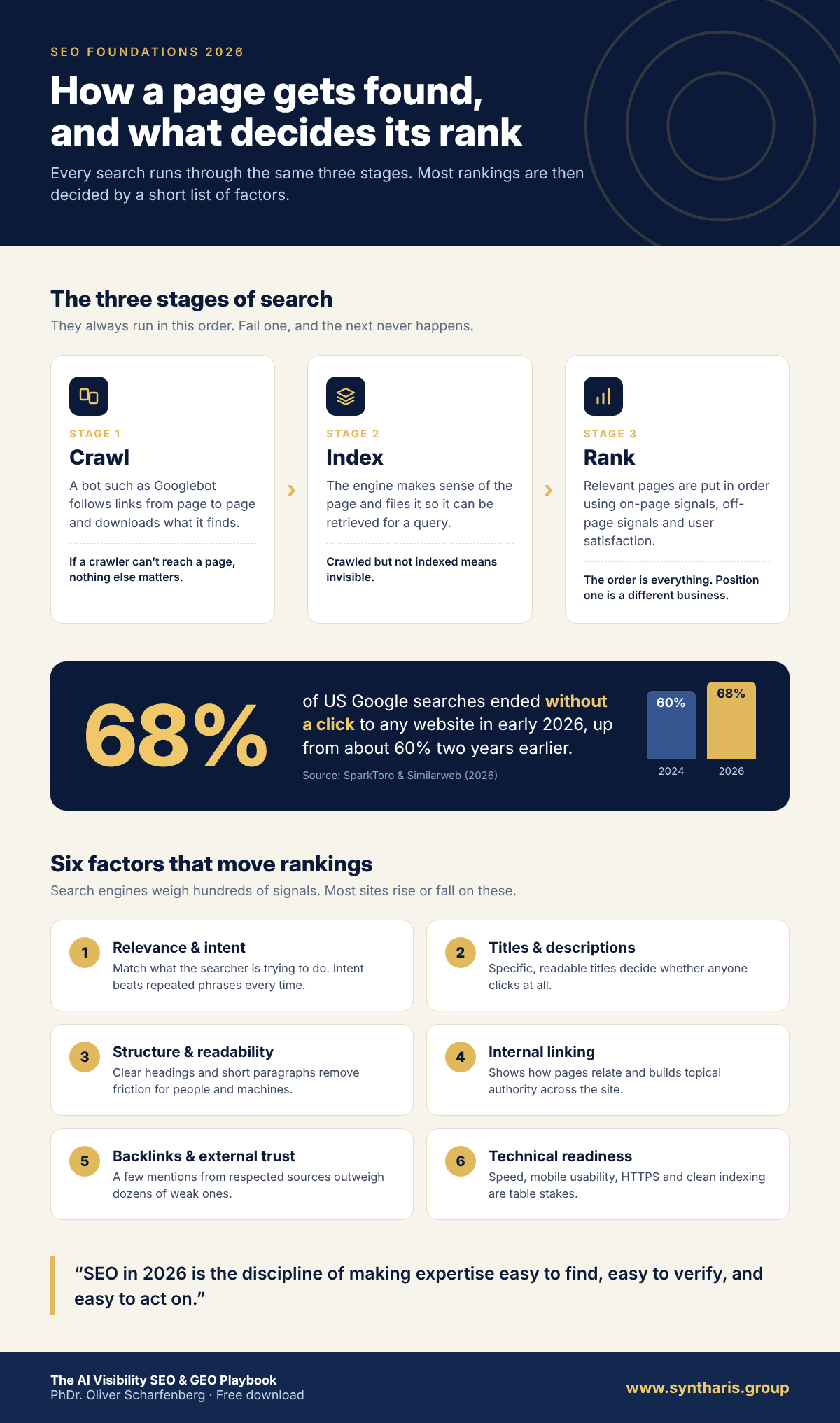
Why all this effort over a position or two? Because attention on a results page is wildly top-heavy. For years the pattern held remarkably steady: the first organic result took the largest share of clicks by a wide margin, the top three together accounted for the clear majority, and almost nobody scrolled to the second page at all. Position one was not a little better than position five. It was a different business. AI answers have since pushed this further in the same direction, compressing many searches into a single response that sits above every link. The curve was always steep, and it is getting steeper.
It is worth being clear about what separates this from paid search, since the two are easy to blur. Paid placement (search engine advertising, or SEA) buys a spot at the top of the page, and you pay for each click it earns. The moment the budget stops, the visibility stops with it. Organic visibility works the other way. It is slower and harder to build, but once a page earns its place, it tends to hold it without charging you for every visitor. That is why an organic ranking behaves like an asset rather than a meter running against you. Paid traffic rents attention, while SEO, done well, owns a share of it.
One last piece of context explains why optimization has always centered on Google in particular. In most Western markets it has carried the overwhelming majority of searches. In German-speaking countries, for years, that meant something like 9 in 10 desktop queries and an even larger share on mobile, which made the other engines almost an afterthought for anyone optimizing a site. That picture is now shifting in a way it had not for over a decade, as AI assistants take a growing slice of search-like questions. The mechanics above still describe how the classic search layer works, and that layer is still where most of the web is found. It is simply no longer the only one.
A Practical Tip: Check That Google Has Actually Indexed You
A page that isn’t indexed cannot rank, however good it is. Pages drop out of the index more often than people think, and you’ll never know unless you look.
What you need. Google Search Console and an XML sitemap (most CMS platforms and SEO plugins generate one automatically).
Setting it up.
Open the “Pages” report under Indexing. It splits your URLs into indexed and not indexed, with reasons.
Read the excluded ones. “Crawled – currently not indexed” and “Discovered – currently not indexed” are the ones to act on.
To check a single important page, paste its URL into the inspection bar. If it’s not indexed, click “Request indexing”.
Confirm your sitemap is submitted under “Sitemaps” and lists the pages you care about.
Optimizing your own site. Do this for your money pages first. If important pages sit in “crawled – currently not indexed”, the usual cause is thin or duplicate content. Strengthen the page rather than just resubmitting it.
The point. Five minutes here occasionally uncovers a page that has been invisible for months.
What SEO Actually Rewards Now
The textbook definition still applies, technically. SEO is the practice of improving a site’s visibility in search. But that sentence no longer explains what drives results, because the criteria underneath it have moved.
In the early years, you could engineer a ranking. Strong keyword targeting, a solid backlink profile and clean technical compliance could carry a page even when the writing was forgettable. That loophole has closed. Search engines, and the AI systems layered on top of them, have gotten far better at judging whether a page actually helps, and not only what it says.
So the work has shifted from optimization toward something closer to editing. Every page needs a reason to exist, and that reason should be obvious within a few seconds, to a reader and to the system scoring it. Vague, sprawling pages tend to underperform, and lack of optimization is rarely the reason. They underperform because nobody can tell what they are for. The pages that win are usually not the most technically advanced. They are the ones that understand their reader well enough to anticipate the next question and answer it without making the reader dig.
Digging is the enemy here. Friction, in SEO terms, is anything that forces extra effort: muddled messaging, a wall of text with no structure, three paragraphs of throat-clearing before the actual answer. Each one raises the cost of reading, and when people expect an instant answer, even small costs send them back to the results page. Reducing that friction is much more than a nicety. It is one of the most reliable ways to get a page prioritized, by readers and by the systems serving them.
Underneath all of it sits a single test: does this page solve a real problem better than the alternatives competing for the same attention? If it does not, no amount of structural polish will rescue it. SEO has grown out of being a technical checklist and into a strategic one. The job is no longer to tune isolated pages. It is to build a body of content that consistently delivers something worth reading, reinforces what you are known for, and matches how people actually search, think and decide.
How Google Learned to Judge Quality
The claim that the old loophole closed is easy to make and worth explaining, because it did not close overnight. It closed in stages, through a sequence of changes to how the search engine judged a page, and knowing that sequence makes the present rules feel less arbitrary. Each step moved the system a little further from counting and a little closer to understanding.
In the early years, the formula really was crude. A page could rank largely on how often it repeated a keyword and how many links pointed at it, regardless of whether either reflected anything a reader would value. That was the loophole, and a whole industry grew up to work it.
The first serious correction arrived in 2011, with an update Google named Panda. It began rewarding genuinely useful, well-written pages and pushing down thin, low-value ones. That was the moment quality started to count as a ranking factor in its own right rather than a nice-to-have. A year later, in 2012, came Penguin, the so-called webspam update, aimed squarely at manipulation: keyword stuffing, schemes built to inflate link counts, and cloaking, the trick of showing search engines one page and visitors another. Sites that had gamed the system lost ground, sometimes sharply.
The biggest change was Hummingbird in 2013, which rewrote the underlying algorithm rather than bolting another filter onto it. Where the engine had mostly matched the individual words in a query, it could now read the query as a whole and reach for the meaning behind it. This was the first real step toward understanding language rather than merely scanning for it, and almost everything I say about intent and meaning descends from that shift.
Two later moves rounded out the pattern. From 2015, and again in 2017, mobile updates favored sites that worked properly on a phone and penalized those that did not, as searching moved off the desktop. And in 2017 an update unofficially called Fred went after a familiar set of weaknesses: pages thin on real content, heavy with ads, or left to go stale. None of these was the last word. Each was refined repeatedly in the years that followed.
Read together, they tell one story. Step by step, the search engine was taught to approximate a careful human reader. It learned to prefer substance over repetition, earned trust over manufactured links, and current, usable pages over neglected ones. These are the same priorities Google still sets out in its own guidance on creating helpful, reliable, people-first content. Seen that way, AI search is the continuation of that arc rather than a break from it: the same preference for genuine quality, now applied by models that read a page more closely than any algorithm before them. The loophole was designed out, deliberately, one update at a time.
A Practical Tip: Repair Thin Pages Instead of Publishing More of Them
Many websites don’t need more content. They need fewer weak pages. Thin pages split attention, waste crawl budget and make the site look less authoritative than it really is.
What you need. Screaming Frog, Search Console, GA4, and a spreadsheet with URL, purpose, traffic, impressions, backlinks and action.
Setting it up.
Crawl the site and export all indexable pages.
Add clicks and impressions from Search Console.
Mark pages with no traffic, no impressions, no links and no clear business purpose.
Group them into keep, improve, merge, noindex, or remove.
Optimizing your own site. Start with pages targeting the same intent. Merge overlapping ones into the strongest URL, redirect the weaker URLs, and fold the best sections into the survivor. If a page is useful for customers but not for search, consider noindex rather than deleting it. Keep a log of every decision.
The point. Quality is partly subtraction. A tighter site is easier for humans, crawlers and AI systems to understand.
On-Page SEO: Where You Still Have Control
On-page optimization remains the heart of the discipline, mostly because it is the part you genuinely control. But control guarantees nothing on its own. Execution does.
Good on-page work starts with focus. Build each page around one clearly defined topic. The moment a page tries to cover three ideas at once, it loses the thread, and so do the reader and the search engine. Structure carries that focus: a title that says what the page is actually about, headings that move the reader through in a logical order, and internal links that tie the page into the larger context of the site. What separates strong pages from average ones is how well these elements work together, far more than whether they are present at all. A well-built page never feels optimized. It feels obvious.
From Broad Topics to Precise Value
Consider HubSpot, one of the most-cited examples of precision beating breadth. Rather than publishing scattered articles aimed at broad marketing terms, HubSpot organized its content into pillar topics supported by tightly interlinked pages. That structure strengthened internal linking, deepened topical authority, and made it far easier for search systems to see how the pieces related. The payoff was visibility across a whole family of related searches and a cleaner experience for readers. The lesson is unglamorous but durable: precision and structure usually outperform reach.
The most common mistake in the other direction is vague, generalized content. On paper, broad topics look strategically safe: wider reach, more flexibility, a bigger potential audience. In practice they do the opposite, because they do not match how anyone actually searches. People search from inside a situation, whether that is a problem to solve, a decision to make or a comparison to settle. Content that ignores that situation reads as less relevant no matter how well it is optimized.
A title like “Marketing Tips” makes the problem obvious. It is too broad to signal intent, too generic to promise value, too vague to attract anyone in particular. It says nothing about who the page is for or what it solves. “SEO Tips for Small Business Websites (2026 Guide)” does the opposite work in a single line. It establishes audience, scope and timeliness, and it tells both the reader and the system exactly what to expect. That clarity lifts engagement, sharpens the match to intent, and gives the page a real chance in a crowded field.
None of this is accidental. It tracks how search engines have evolved to read intent rather than count keywords, weighing the relationship between the query, the page, and the outcome the user is after. Tightly aimed content surfaces more easily because it removes ambiguity and raises the odds that the reader leaves satisfied. The trade is straightforward: precision narrows your reach and increases your relevance, and relevance is what moves the needle. It matters most in crowded markets, where generic content is everywhere and high-authority domains already own the broad terms. Compete there and you are fighting giants. Aim at a sharper segment and the intent is clearer, the competition thinner and the conversion better, because a page written for a specific person with a specific problem earns more trust than one written for everyone.
A Practical Tip: Rewrite the Titles That Get Ignored
Some pages rank perfectly well and still get no clicks, because the title in the results gives nobody a reason to choose them. This is different from the page-two problem: these pages are already on page one. The fix is the title, not the ranking.
What you need. Google Search Console and a few minutes per page.
Setting it up.
In the Performance report, add the CTR and Position columns.
Filter to pages in positions 1 to 10.
Sort by impressions and scan for a click-through rate well below its neighbors. A page ranking fourth with a 1% CTR is leaving clicks on the table.
Optimizing your own site. Rewrite the title tag so it reads like an answer, not a label. Lead with the number or the benefit (“…in 2026”, “7 steps”, “without an agency”), keep it under about sixty characters so it isn’t cut off, and write a meta description that finishes the thought rather than repeating the title.
The point. You already have the ranking. You’re simply giving searchers a reason to pick you over the result above, and that is the cheapest traffic you’ll ever earn.
Want the full picture? Chapter 1 is only the start. The AI Visibility SEO & GEO Playbook goes on to cover AI search engines, Generative Engine Optimization, E-E-A-T, entity optimization and a complete 90-day plan. Download it free at www.syntharis.group.
Starting From the Words People Use
Before the question of intent comes a humbler one: which words do people actually use, and does anyone use them at all? It is an easy step to skip, and skipping it is how businesses end up writing carefully optimized pages for phrases nobody searches. The fix is plain research. A tool like Google’s Keyword Planner will show roughly how many times a term is searched in a month, which is usually enough to tell a phrase worth thousands of queries from one worth ten.
An example makes the gap concrete. A retailer planning content around sewing machines might assume the premium model is the place to start, only to find that the entry-level machine is searched many times as often, and a beginners’ guide more often still. Same product category, very different demand, and you only see it by checking. The point is not to chase whatever has the biggest number. It is to know the numbers before you commit, so effort follows real demand rather than a guess.
High volume is not the goal in any case. The biggest terms are usually owned by the biggest sites, and competing for them head-on is a slow, expensive fight. A narrower phrase, with fewer searches, clearer intent and far less competition, often returns more, because the handful of people searching for it are closer to knowing what they want. A query that draws ten searches a month from exactly the right person can be worth more than one that draws thousands from nobody in particular. Precision beats volume here for the same reason it does everywhere else.
There is a catch that keeps this from collapsing back into old-fashioned keyword chasing. Modern engines no longer reward the page that repeats a phrase most often. They read a page as a whole and treat synonyms and related terms as part of the same idea, so “inexpensive”, “affordable” and “low-cost” register as one concept rather than three separate targets. Titles and meta descriptions still earn their keep and still deserve the right words, but the weight has moved from hitting an exact term to covering a subject thoroughly and naturally. Keywords are where the research starts. They are no longer where the writing ends.
The way people phrase their searches is changing too, and it pushes in the same direction. More queries are now spoken aloud or typed as complete questions rather than clipped fragments (“what’s the best CRM for a small team?” instead of “best CRM small business”), because voice assistants and AI chat have made full, natural questions the norm. Longer, more conversational queries reward content written the way people actually ask, which is exactly the move from matching keywords to answering questions. The research tells you what to write toward. Intent, the subject of the next section, tells you what to do once you know.
A Practical Tip: Find the Page-Two Keywords That Can Move This Month
Most sites already own a few small wins. They aren’t hidden in a strategy deck. They sit in Search Console, usually on page two, picking up impressions but not enough clicks. Moving one page from position twelve to eight often does more than publishing another average article.
What you need. Google Search Console, a spreadsheet, and one hour without meetings. Optional: Ahrefs, Semrush, Sistrix or DataForSEO for richer keyword data.
Setting it up.
Open Search Console and choose Performance > Search results.
Set the date range to the last three months.
Switch on Clicks, Impressions, CTR and Average position.
Export queries and pages to a sheet.
Optimizing your own site. Filter for queries between position 8 and 20, with at least 100 impressions and a low CTR. Pick five. For each one, open the ranking page and improve only what helps that searcher: add the missing answer near the top, tighten the title, add a small comparison table, refresh the date, and link to it from two stronger pages. Don’t rewrite the whole page. Make the useful part easier to find.
The point. This is fast SEO because you’re not guessing. Google has already tested the page. You’re just giving it a better reason to move.
The Shift from Keywords to Intent
For years, SEO ran on keywords. You found high-volume terms, worked them into your content, and tuned pages to rank for them. Keywords still tell search systems something, but they are no longer what drives performance. Intent does. Intent is the reason behind the search.
That distinction changes the work. A keyword is a signal, and intent is the meaning behind the signal. Modern systems read that meaning with steadily improving accuracy, using context, prior behavior and semantic understanding to infer what someone is actually trying to do. Reading it yourself means stepping into the searcher’s shoes. A query is a goal, much more than a string of words. The goal might be to understand something, to compare options, or to act, and each one carries a different expectation. Content has to meet the right one.
This is where a lot of strategies quietly fail. The content is neither badly written nor technically broken. It simply answers the wrong question. There is a real gap between matching a keyword and matching the intent behind it, and a page can nail the first while missing the second entirely. Someone looking for recommendations does not want a definition. They want options, comparisons and a clear steer. Someone close to buying does not want a primer. They want reassurance and an obvious next step. Miss that, and you create friction, and friction sends people away.
Search engines and AI systems are increasingly tuned to that mismatch. They assess not only whether a page is relevant to a query but whether it satisfies the intent behind it, although Google does not confirm that any single engagement metric is a direct ranking factor. Search systems are optimized for user satisfaction, and a persistent mismatch tends to surface indirectly in performance data over time. Content that keeps missing intent gradually loses ground, however well optimized it is elsewhere.
The harder part is that intent is not fixed. The same keyword can mean different things depending on context, timing and the person typing it, which means content has to be clearly positioned within a specific intent rather than hedging across all of them. The closer it sits to what the reader actually meant, the better it performs, and the easier it becomes for systems to interpret, extract and surface. Matching what people type was always the easy half. Understanding what they mean is the half that pays.
Why Most SEO Strategies Underperform
Given the volume of tools, frameworks and free knowledge available, it is striking how many SEO strategies stall. The cause is rarely technical. It is misalignment.
Most businesses treat SEO as a production line rather than a problem-solving system. The instinct is to publish more, target more terms and push content velocity up, on the assumption that more pages mean more visibility and more visibility means more results. That chain snaps almost immediately. Content produced without a clear purpose drifts. It may be optimized on the surface, but it does nothing for the reader’s decision, so it sits in the results, taking up space without making a dent.
The distinction that matters here is between activity and effect. A site can earn impressions, rank for dozens of terms, and still change nothing, because traffic in that situation measures presence, not value. Outdated scoreboards keep the illusion alive. Plenty of teams still judge SEO by rankings and traffic growth rather than business impact, and as click-through rates fall under AI answers, those numbers say less and less. Rand Fishkin has made this case for years: traffic chased for its own sake, without engagement or conversion behind it, does not translate into anything a business can bank.
The root problem is that strategies get built around keywords instead of problems. Keywords are abstractions, while problems are real. Optimizing for a single phrase tends to lose the context behind it, producing pages that are technically relevant but practically useless. The reader lands, skims and leaves. Effective SEO starts from the other end, with the problem. What is this person trying to do? What is in their way? What would actually move them forward? Content built on those questions is more valuable because it maps to real situations rather than theoretical search patterns.
The second common failure is choosing volume over clarity. The pressure to publish on a schedule produces thin, repetitive, derivative pages, which look like progress and quietly erode authority. Systems are increasingly good at spotting the pattern, and they do not reward output for its own sake. They reward consistent value.
Underneath both failures is the gap between visibility and influence. Making content visible is not the same as making it persuasive. A page can appear thousands of times and matter not at all if it does not land. Influence is what converts visibility into outcomes, and it is built the slow way, through clarity, relevance and earned trust.
So the shift required is conceptual rather than tactical. Move from “how much can we publish?” to “how well does this perform against a specific goal?” Every page should justify itself by doing a defined job: teaching something, supporting a decision, reinforcing authority. Trace most failing strategies back far enough and you find the same root. They are organized around what the business wants to say, and not around what the reader needs. Fix that and the rest starts to move. The point was never to make content that can be found. It is to make content that matters once it is.
Structure as a Competitive Advantage
Structure is no longer a technical afterthought. It is one of the clearest advantages a page can have, because how content is organized determines how it gets read, by people and by machines.
Start with people. Clear organization lowers the effort it takes to extract value, which cognitive scientists would call reducing cognitive load. When a reader can find what they came for quickly, they are more likely to stay, trust the page and keep going. Readers do not study a page line by line. They scan, filter and judge relevance in seconds. A well-structured page works with that behavior instead of against it. A wall of undifferentiated text fights it, and good insights buried in that wall may as well not be there.
Machines read differently but care about the same thing. Search engines and AI models do not experience a page the way you do. They lean on signals such as headings, hierarchy, semantic relationships and contextual cues to work out what it means. Content that is cleanly segmented hands those systems stronger signals, which makes it easier to identify the key ideas, pull the relevant passage, and decide how the page should rank or be cited. As systems get better at mapping the relationships between topics and pages, that advantage compounds.
Structure also makes content portable. A well-organized page is easier to summarize, repurpose and distribute across other platforms and AI surfaces, while an unstructured one stays locked to its original form. When attention is scarce and competition is heavy, the content that wins is often the most legible, which is not always the same as the most valuable.
Internal Linking and Context
Zapier is a good illustration of legibility at scale. Much of its organic visibility comes from a large body of structured content stitched together by deliberate internal links. Pages on automation, integrations, workflows and productivity reinforce one another through clear topical relationships, so the site reads as a connected system rather than a pile of standalone articles, and it performs across thousands of workflow- and automation-related searches.
Internal linking is one of the most underrated parts of SEO, and one of the most misunderstood. People treat it as plumbing, dropping links between pages, when it is really a way of building context. Every page lives inside a larger body of information. Left isolated, a page means only what it says on its own. Linked thoughtfully, it joins a web of relationships that lets both readers and search engines see how ideas connect, which turns a collection of pages into something closer to a knowledge base.
To a search engine, internal links signal importance and relevance. They spread authority through a site, steer crawlers toward the pages that matter, and clarify what should be prioritized. Pages that are linked often, and on purpose, tend to be read as central. But the real value goes beyond the technical. Good internal linking guides a reader through a logical journey, anticipating the next question and answering it before they have to leave and look elsewhere. That is guidance more than navigation, and it builds trust by making your content feel comprehensive rather than fragmentary.
What has changed lately is how much this contributes to context-building. Systems no longer judge pages in isolation. They assess how well a site demonstrates depth and consistency within a topic. A single article on SEO has some value alone. Connect it to related pieces on technical SEO, content strategy and AI-driven search, and it becomes part of a larger narrative that signals real expertise in the area. Fragmented or carelessly linked content does the reverse: even strong individual pages lose force when nothing ties them together.
There is a strategic dimension too. Every link is a decision point that determines where the reader goes next and how their sense of your brand develops. Handled deliberately, internal linking lets you shape that path, from first awareness toward understanding and eventually toward action. Most implementations fall short here because links get added reactively, without regard for intent, hierarchy, or the larger story the site is trying to tell. Doing it well takes planning: identifying the key topics, organizing content around them, and building clear routes between them, with each link there for a reason. Visibility is no longer decided by individual pages. It is decided by how well those pages work together.
A Practical Tip: Use Internal Links Like Recommendations, Not Furniture
Internal links are one of the fastest ways to strengthen a page. The mistake is adding them mechanically. A good internal link feels like a helpful recommendation at the exact moment the reader needs the next step.
What you need. Screaming Frog, Sitebulb, or simply a search using site:yourdomain.com plus your keyword.
Setting it up.
Choose one page you want to lift.
Search your own site for pages that already mention the topic.
Find three with traffic, backlinks or strong topical relevance.
Add one contextual link from each to the target page.
Optimizing your own site. Use natural anchor text. “See our employer-branding checklist” beats repeating the exact keyword ten times. Add links inside paragraphs where they help the reader continue, and link back from the target page to related supporting pages so the cluster is clear. To find orphaned pages, check the “Inlinks” count in a crawl. Anything at zero or one needs links.
The point. Internal links tell readers and crawlers which pages belong together. Done well, they move authority and make your expertise easier to follow.
What Actually Moves Rankings
Search engines weigh a long list of signals, but most sites rise or fall on a much shorter one. These are the factors worth your attention first.
Relevance and intent. A page performs when it matches what the searcher is trying to do, which goes well beyond stuffing in keywords. Advice-seekers expect guidance, comparison-shoppers expect options laid out clearly, and service-seekers expect credibility and an obvious next step. Matching intent beats repeating phrases, every time.
Titles and descriptions. The title is still one of the clearest signals of what a page is about, and it heavily influences whether anyone clicks. Strong titles are specific, readable and aligned with the query. Meta descriptions may not move rankings directly, but they shape click-through by helping people decide whether a result looks worth their time.
Structure and readability. Systems favor content they can interpret easily, and readers favor content they can consume easily. Clear headings, short paragraphs, a logical sequence and concise explanations all help, because each one removes friction.
Internal linking. Links help search engines understand how pages relate and help readers move naturally through a site. It remains one of the simplest ways to strengthen topical authority.
Backlinks and external trust. Links, mentions, reviews and references from credible third parties still count, because they reinforce trust. Quality dwarfs quantity here: a handful of relevant mentions from respected sources outweighs dozens of weak ones.
Technical readiness. Even excellent content underperforms on a site that is hard to crawl or use. Speed, mobile usability, secure browsing, clean indexing and a stable architecture are table stakes.
Where This Leaves You
If you take one thing from this article, let it be this: the basics of SEO have not disappeared, they have been raised. Crawling, indexing and ranking still decide whether you exist in classic search. What has changed is the standard a page has to meet once it is found. It has to match a real intent, be easy to read for people and machines, sit inside a clear structure of related pages, and come from a brand the wider web already trusts.
That last point is where classic SEO meets the newer discipline of Generative Engine Optimization, or GEO. When an AI system writes the answer, the question is no longer only whether you rank, but whether you are named. The rest of the book picks up exactly there: how ChatGPT, Perplexity, Gemini and Google’s AI features choose their sources, how to structure content they can quote, and how to measure a kind of visibility that often never shows up as a click.
Download the complete book for free. The AI Visibility SEO & GEO Playbook by PhDr. Oliver Scharfenberg covers everything from the foundations of SEO to a step-by-step GEO plan, ten case studies, ready-to-use templates, 50 monitoring prompts and 100 AI visibility prompts. Get your free copy at www.syntharis.group.
Sources
- Google Search Central (n.d.). Search documentation, including “SEO Starter Guide” and “Creating Helpful, Reliable, People-First Content”. developers.google.com/search
- SparkToro and Similarweb (2026). The state of search: Google searches, clicks, and zero-click searches. sparktoro.com
- Schmitt, M. C. (2019). Suchmaschinenoptimierung (SEO). In: Quick Guide Digitale B2B-Kommunikation. Wiesbaden: Springer Fachmedien.
- Sens, B. (2019). Das Online-Marketing-Cockpit in der Praxis. In: Das Online-Marketing-Cockpit. Wiesbaden: Springer Fachmedien.
- HubSpot (n.d.). Topic clusters: the next evolution of SEO. HubSpot Marketing Blog.
- Sullivan, D. (n.d.). How Search Works. Google. google.com/search/howsearchworks
- Fishkin, R. (2025). SparkToro: analyses of search behavior, engagement and the limits of traffic as a measure of success. sparktoro.com



We Are Here
to Support You.
We Are Here
to Support You.
Whether you have a question, a project in mind or want to learn more about our services – we look forward to hearing from you.
Our Dubai Office
IFZA Business Park, DDP 65843-001
Silicon Oasis, Dubai, UAE
Business Hours
9:00 AM – 6:00 PM (GST)
SEO Foundations in 2026: How Search Engines Actually Work and What They Reward Now
Oliver Scharfenberg2026-10-10T16:55:50+00:00October 10, 2026|AI Visibility & GEO|
How crawling, indexing and ranking really work in 2026, why zero-click search changes the rules, and what Google rewards today. Adapted from The AI Visibility SEO & GEO Playbook.
Get the latest insights delivered to your inbox.
Get the latest insights delivered to your inbox.
Join a growing community of leaders, marketers, HR professionals and educators who are shaping a more visible tomorrow.
More Insights
More Insights
Let’s Build a Brighter Tomorrow for Your Business.
Let’s Build a Brighter Tomorrow for Your Business.
Book a free consultation and find out how we can increase your visibility in search engines and AI answers.