AI SEO in 2026: What Changed in Search and What Still Works
Ask ten marketers what “AI SEO” means and you will get two different answers, often from the same person. Some mean using ChatGPT, Gemini or Claude to do search work faster: keyword clustering, briefs, drafts, audits. Others mean getting a brand into the answers that Google’s AI Overviews, AI Mode, ChatGPT search or Copilot write for their users. Most guides blend the two, add a tool list and call it a strategy. That is how teams end up publishing hundreds of machine-written pages in the hope of being cited by machines.
This article keeps the two meanings apart, because they rest on different evidence and carry different risks. It looks at what has measurably changed in search since AI answers arrived, what Google and other platforms actually tell site owners in 2026, and what controlled studies say about using language models for professional work. The second half turns that into a workflow with clear human checkpoints and a way to measure results that does not depend on a single screenshot of a chatbot answer.
Two things people mean by “AI SEO”
The first meaning is AI for SEO: language models as tools inside the existing SEO process. The question here is productivity and quality. Does the model help your team do the same work faster without introducing errors?
The second meaning is SEO for AI search: making sure your content is found, used and represented correctly when an AI system writes the answer instead of listing ten links. The question here is visibility. When a buyer asks an assistant about your category, does your brand show up, and is what it says about you true? This second meaning overlaps almost completely with what is also called generative engine optimization (GEO) or answer engine optimization (AEO). We have looked at the research behind that label in detail in our review of generative engine optimization and what the studies actually show, so this article only touches the parts that matter for day-to-day SEO decisions.
| AI for SEO | SEO for AI search | |
|---|---|---|
| Goal | Do search work faster and more thoroughly | Be retrieved, cited and described correctly in AI answers |
| Typical tasks | Clustering, briefs, drafts, metadata, log and crawl analysis | Crawler access, non-commodity content, entity consistency, earned coverage |
| Main risk | Errors and generic content at scale | Wasting budget on tactics with no measured effect |
| Best evidence | Controlled experiments on knowledge work, Google’s content guidance | Platform documentation, click studies, retrieval research |
| How to measure | Time saved, error rate, quality ratings, rankings of the output | Search Console and Bing AI reports, repeated prompt panels, accuracy checks |
Keeping these apart prevents the most common mistake: assuming that because a model can write a page, a model will want to cite it. The two questions have different answers.
What actually changed in search between 2024 and 2026
AI answers became a normal part of the results page
Google no longer treats AI answers as an experiment. In its second-quarter 2026 earnings remarks, Alphabet CEO Sundar Pichai said AI Mode had passed one billion monthly active users since its global expansion in October 2025, and that Google was bringing AI Overviews and AI Mode together into one search experience. In the third-quarter remarks on October 28, 2026, he added that queries in AI Mode are on average three times longer than traditional searches and that one in five AI Mode searches worldwide uses voice, images or documents. These are company figures without an external audit, but the direction is clear: people type longer, more conversational questions, and a growing share of them see a written answer before any link.
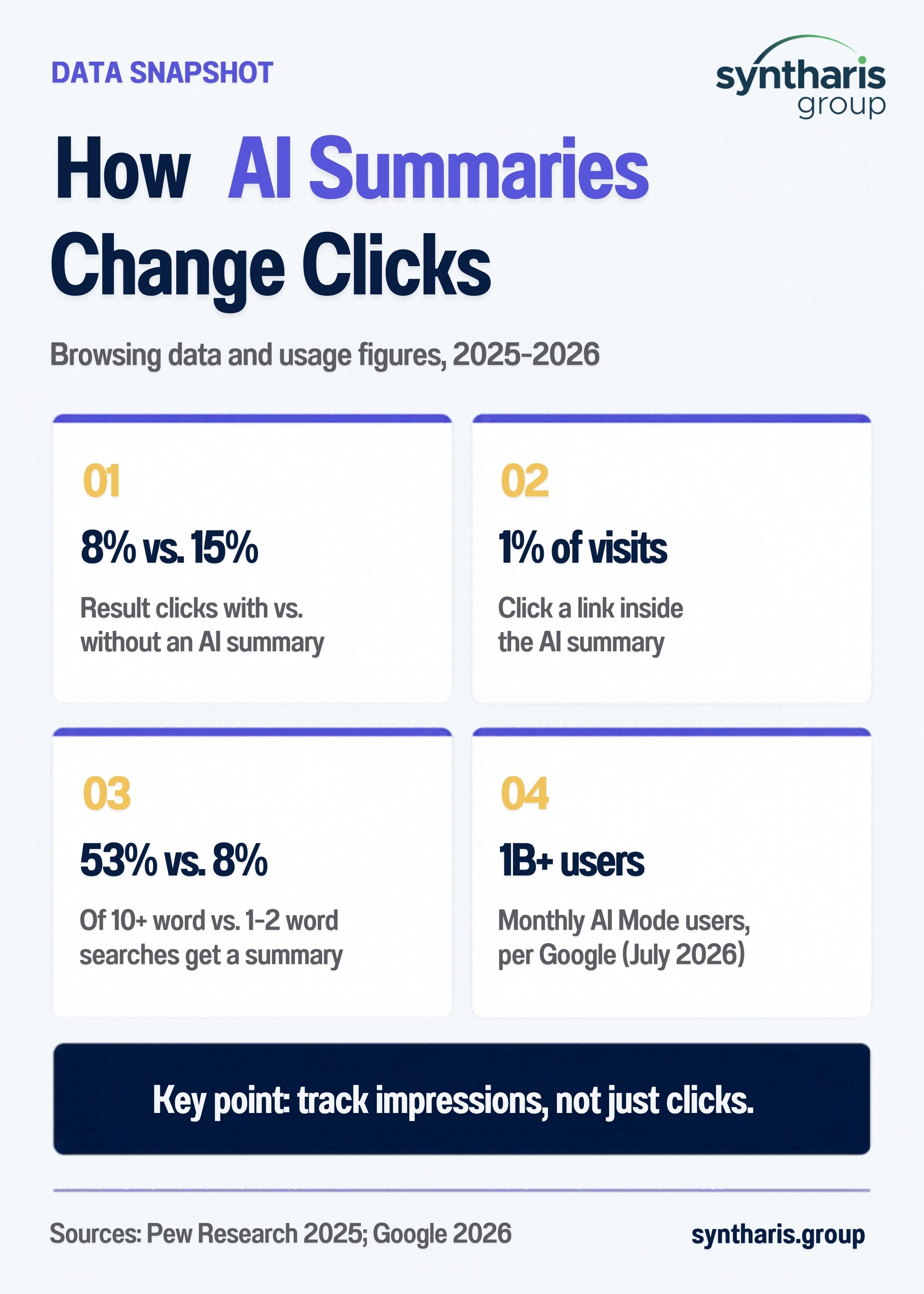
Longer questions matter for SEO because they are the ones most likely to trigger an AI summary in the first place. Pew Research Center found that only 8 percent of one- or two-word Google searches in its data produced an AI summary, compared with 53 percent of searches with ten or more words. Searches that started with a question word such as “who”, “what” or “why” produced a summary 60 percent of the time.
Fewer clicks per search on informational queries
The best independent data on behavior comes from Pew. Athena Chapekis and Anna Lieb analyzed the real browsing data of 900 U.S. adults in March 2025, covering 68,879 unique Google searches. About 18 percent of those searches produced an AI summary. When a summary appeared, users clicked a traditional result in 8 percent of visits. Without a summary, they did so in 15 percent of visits. Links inside the summary were clicked in only 1 percent of visits, and users ended their browsing session more often after a page with a summary (26 percent versus 16 percent).
Two points about the design are worth knowing. Pew observed real behavior rather than asking people what they do, which makes the data more trustworthy than a survey. On the other hand, the search pages were re-collected with a scraping service in April 2025, a few weeks after the original searches, so the summary a person saw may have differed slightly from the one recorded. And the comparison is between different searches, not the same search with and without a summary. Questions that trigger summaries may simply be questions people are less inclined to click on.
Industry studies point the same way but deserve more caution, because they come from companies that sell SEO software or services and use correlational designs. The SEO software company Ahrefs compared position-one click-through rates for 300,000 keywords using aggregated Search Console data from December 2023 and December 2025. It estimated that the presence of an AI Overview went along with a 58 percent lower click-through rate for the top result, up from 34.5 percent in its earlier analysis. The agency Seer Interactive tracked 5.47 million queries across 53 brands from January 2025 to February 2026. Its data showed organic click-through on queries with an AI Overview falling to 1.3 percent in December 2025 and then recovering to 2.4 percent by February 2026, which the authors themselves describe as directional. Seer also found that brands cited inside the AI Overview earned about 120 percent more organic clicks per impression than brands that were not cited on the same kind of results page, while still trailing queries with no AI Overview at all. As the authors point out, stronger brands are also more likely to be cited, so this is not proof that the citation itself causes the clicks.
Google disputes the conclusion that its AI features reduce valuable traffic. In the second-quarter remarks, Pichai said Google sends “billions of clicks to websites every week” through AI features in Search, and the company has repeatedly said that clicks from AI results are of higher quality. Both readings can be true at once: fewer clicks per informational query, more searches overall, and visitors who arrive better informed. For planning, the practical consequence is the same. Informational content that answers a simple question will earn fewer visits than it did in 2023, and reporting that only counts sessions will understate the reach your content has inside the answer.
Answers are assembled from several sources at once
AI search products work in two stages. A retrieval system finds candidate pages, and a language model writes the answer from some of them. Google describes this directly for AI Overviews and AI Mode: its core ranking systems retrieve the pages, and the model may run several related searches in parallel, a technique Google calls query fan-out. A page can therefore be cited for a question it never targeted, as long as it ranks for one of the sub-questions. The practical lesson is that topical depth across related questions matters more than squeezing one keyword into a page. How retrieval and ranking work underneath is covered in our guide to how search engines work in 2026.
Citations are not always accurate
Being cited does not guarantee being represented correctly. In March 2025, Klaudia Jaźwińska and Aisvarya Chandrasekar of the Tow Center for Digital Journalism at Columbia University tested eight AI search tools with 1,600 queries. Each query was an excerpt from a real news article, and the tool had to name the headline, publisher, date and URL. Collectively, the tools answered more than 60 percent of the queries incorrectly, often without signaling any doubt, and several returned broken or invented links. The test was narrow, focused on news, and the systems have changed since. It still shows why a brand should check what AI answers say about it, not only whether it appears.
What has not changed
The quieter story of 2026 is how much of classic SEO still decides who appears in AI answers. Google’s guide “Optimizing your website for generative AI features on Google Search”, published on May 15, 2026, says plainly that from the perspective of Google Search, optimizing for generative AI is still SEO. Its main points are familiar:
- Pages must be crawlable, indexed and eligible to show a snippet. A page that cannot be retrieved cannot be cited.
- Unique, “non-commodity” content will likely influence presence in generative search more than anything else in the guide. Ten pages that say the same thing give a model no reason to prefer yours.
- Google’s spam policies apply to generative AI responses as well. Creating pages for every fan-out variation mainly to manipulate results falls under scaled content abuse.
- Accurate business data in Google Business Profiles and Merchant Center feeds can be used in AI answers.
The same guide lists things site owners can ignore for Google Search: llms.txt files and other special AI markup, splitting pages into small “chunks” for machines, rewriting content specifically for AI, chasing inauthentic mentions, and overinvesting in structured data, which remains useful for rich results but is not required for generative features. Bing’s advice leans slightly more toward clear structure, tables and FAQ sections, but neither platform asks for a separate kind of content.
Outside Google, eligibility comes down to crawler access. OpenAI separates OAI-SearchBot, which decides whether a site can appear in ChatGPT search answers, from GPTBot, which relates to model training. Anthropic separates ClaudeBot (training) from Claude-SearchBot and Claude-User. A company can refuse training and still allow its pages to be found in AI search. Many robots.txt files written in 2023 block every crawler with “AI” in its name and quietly remove the site from AI search as a result. Google also offers a separate control in Search Console that decides whether a site’s content can appear in and help ground its generative AI features; Google says the setting is not used as a ranking signal for regular results.
Using AI for SEO work: what the evidence says
Productivity gains are real, within limits
The cleanest evidence on language models in writing work comes from a preregistered experiment by Shakked Noy and Whitney Zhang of MIT, published in Science in July 2023. They gave 453 college-educated professionals realistic, paid writing tasks from their own fields, such as press releases, short reports and delicate emails, and randomly gave half of them access to ChatGPT. Average time per task fell by 40 percent, and output quality, rated blind by professionals from the same occupations, rose by 18 percent. Weaker writers gained the most.
A field experiment with 758 consultants at Boston Consulting Group, led by Fabrizio Dell’Acqua of Harvard Business School, added an important qualification. On tasks within the model’s capabilities, consultants with GPT-4 completed 12.2 percent more tasks, worked 25.1 percent faster and produced results rated more than 40 percent higher in quality than the control group. On a task chosen to lie just outside those capabilities, however, consultants using AI were 19 percentage points less likely to reach the correct solution. The authors call this a “jagged technological frontier”: tasks of similar difficulty can fall on either side of it, and people cannot easily tell which side they are on. This study was released as a working paper, so treat the exact figures with some caution.
For SEO teams, the translation is straightforward. Drafting, summarizing, restructuring and generating variations are usually inside the frontier. Judging what a search result is really missing, verifying a statistic or deciding which claim your company can stand behind often are not.
Language models can judge relevance, with caveats
One of the more interesting findings for SEO comes from inside a search engine. Paul Thomas, Seth Spielman, Nick Craswell and Bhaskar Mitra of Microsoft reported at ACM SIGIR 2024 that GPT-4, prompted with carefully chosen instructions, produced relevance labels for search results that matched real searchers’ preferences about as well as human labelers, and better than less trained crowd workers. Bing has used this approach at scale. The same paper also found that accuracy changed with simple paraphrases of the prompt. For practitioners this suggests a sensible use: let a model pre-sort pages or queries by likely intent, then check a sample against real data, such as the queries that actually bring traffic in Search Console.
Why fact-checking is not optional
Google’s own documentation now explains the problem in plain terms. In its guidance on using generative AI content, last updated in October 2026, Google reminds site owners that generative models do not retrieve facts but predict a likely sequence of words, which is why their output can contain errors. It calls it important to manually fact-check all AI-generated content for accuracy and trustworthiness before publishing, and it extends this explicitly to metadata such as title elements, meta descriptions, structured data and image alt text, all of which can appear in search results. This is easy to overlook in practice: teams often review the article but let a model fill in titles and schema without a second look.
AI content is not penalized for being AI content
Google’s position has been consistent since February 2023: it rewards helpful content however it is produced, and using automation, including AI, to generate content with the primary purpose of manipulating rankings violates its spam policies. In March 2024 Google broadened the scaled content abuse policy to cover mass-produced, low-value pages whether they come from automation, people or both. After the March 2024 core update had rolled out, Google said it was showing 45 percent less low-quality, unoriginal content in results than before. The current guidance points to the sections of the Search Quality Rater Guidelines that cover scaled content abuse (4.6.5) and main content created with little effort, originality or added value (4.6.6). Rater scores do not change rankings directly, but they show what Google’s systems are tuned to recognize.
AI assistance is also no longer a differentiator. A study by Weixin Liang and colleagues at Stanford, published in Patterns in 2025, estimated that by late 2024 roughly 24 percent of corporate press release text and nearly 10 percent of job postings from small firms showed signs of language model assistance. When everyone can produce a competent draft in minutes, the draft itself carries no competitive value. What remains scarce is first-hand data, documented methods, expert judgment and accountability.
A note on AI detectors
Some teams try to manage risk by running drafts through AI detectors. The evidence argues against relying on them. An earlier Stanford study by Liang and colleagues, also in Patterns, tested seven widely used detectors on essays by non-native English writers. On average the detectors flagged more than 61 percent of these human-written essays as AI-generated, while they judged essays by native writers almost perfectly. Simple rewording also fooled the detectors in the other direction. A detector score says little about whether content is accurate or helpful, which is what search engines and readers care about.
A practical AI SEO workflow with human review
The research points to a division of labor rather than a choice between “human” and “AI”. Models handle volume and first drafts; people handle judgment, evidence and accountability. The table shows how this can look for common SEO tasks.
| Task | What the model does well | What a person must decide or check | Typical failure if unchecked |
|---|---|---|---|
| Keyword and topic research | Clustering large lists, grouping by intent, suggesting sub-questions | Real search demand and business relevance, using Search Console and SERP data | Invented search volumes, topics nobody searches for |
| Competitor and SERP analysis | Summarizing top pages, listing headings and covered subtopics | Which gaps matter, which claims in competitor pages are wrong or outdated | Copying the consensus instead of improving on it |
| Briefs and outlines | Structure, question lists, draft FAQ | Angle, original data, expert input, what the company can prove | Generic “ultimate guide” with nothing new |
| Drafting | First draft, rewording, shortening, translation drafts | Every fact, number, date and quote against the source; voice and tone | Hallucinated statistics and sources |
| Metadata and schema | Title and description variants, schema templates | Accuracy, uniqueness, match with visible content, validation | Misleading snippets, invalid or inaccurate markup |
| Technical audits | Reading logs and crawl exports, explaining errors, writing scripts | Prioritization and impact, testing before deployment | Fixes that break templates or block crawlers |
| Internal linking | Suggesting related pages and anchor text | Relevance and natural placement | Over-optimized anchors, links that add nothing |
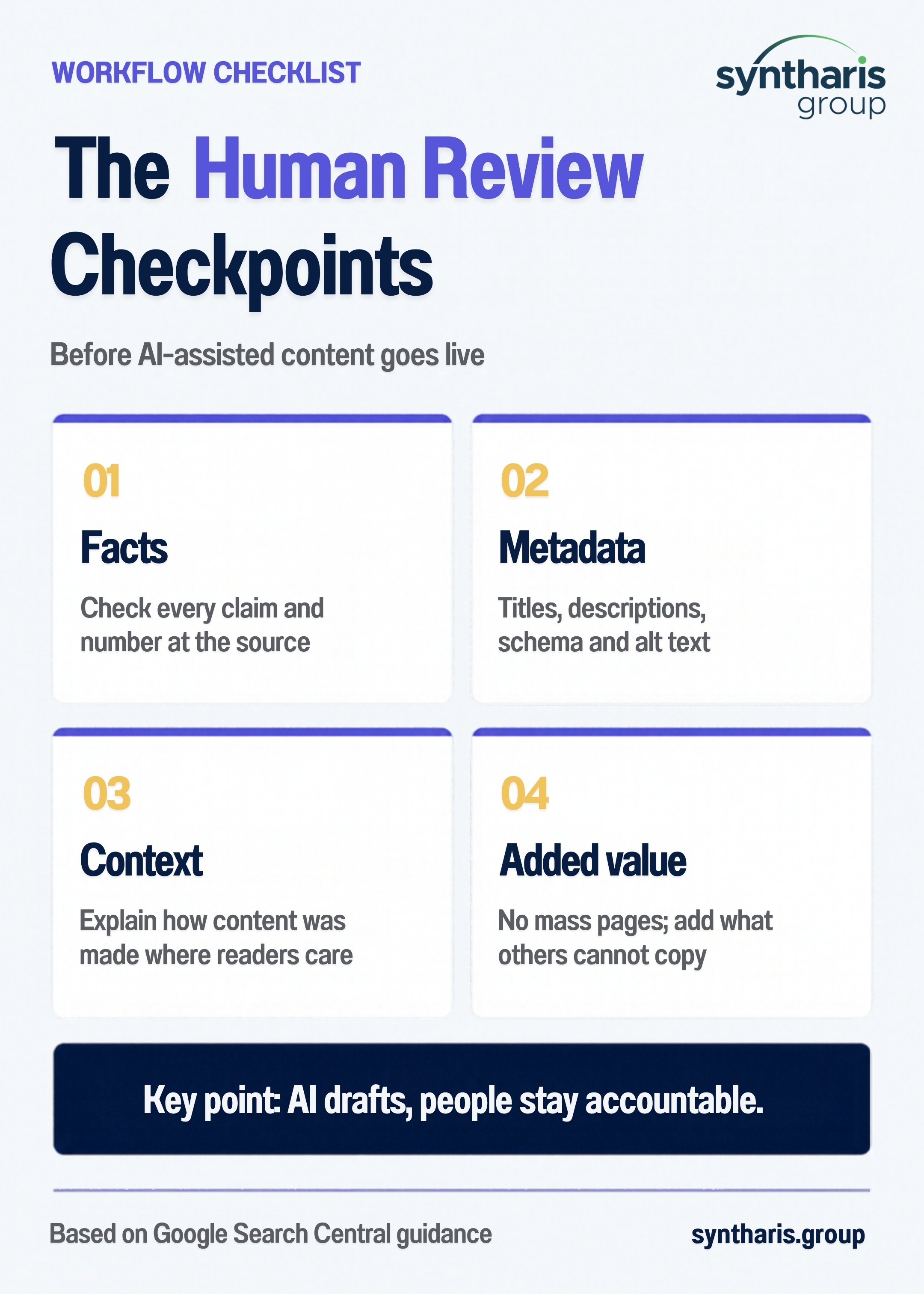
In practice, a workflow that holds up looks like this:
- Start from data, not from the model. Pull real queries from Search Console, the current top results and the questions your sales and support teams hear. Give these to the model as input instead of asking it what people search for.
- Define what only you can add. Before anything is drafted, write down the original element: your own figures, a method you use with clients, a documented case, an expert’s judgment. If there is nothing, reconsider whether the page should exist.
- Let the model draft, then rebuild. Use the draft as raw material. An editor restructures it around the original element and removes filler, repetition and empty phrases.
- Verify every fact at the source. Every number, date, name and quotation is checked against the primary source and linked. Anything that cannot be verified is cut.
- Review metadata separately. Titles, descriptions, alt text and structured data get their own review step, as Google’s guidance asks.
- Add context where readers would expect it. Clear bylines, author expertise and, where it helps the reader, a note on how the content was produced.
- Publish less, update more. Fewer, better pages that are kept current beat a large archive that nobody maintains. Scale is exactly what the scaled content abuse policy looks at.
Making your pages usable for AI search
The “SEO for AI search” side is mostly a checklist of fundamentals, applied with AI answers in mind.
- Check access deliberately. Review robots.txt and any CDN or firewall rules for Googlebot, Bingbot, OAI-SearchBot and Claude-SearchBot. Decide on training crawlers separately. Check the generative AI setting in Search Console.
- Cover the questions behind the question. For each core topic, list the sub-questions a fan-out search would explore and make sure your best page answers them, without creating a thin page for each one.
- Publish evidence people can cite. Original data, clear definitions, documented methods and dated figures with named sources are what make a page worth quoting.
- Keep facts consistent everywhere. Company name, services, locations, leadership and key figures should match across your website, business profiles, directories and social profiles. Inconsistent data invites wrong answers.
- Earn genuine third-party coverage. AI answers often draw on independent sources such as trade media, associations and reviews. That is public relations and expertise, not link schemes.
- Write for people, structure for scanning. Clear headings, direct answers near the top, short paragraphs and tables where the data is tabular help readers and machines alike.
If you want a structured version of this checklist, our CEO’s free book The AI Visibility SEO & GEO Playbook walks through it step by step, and our AI visibility consulting for SEO and GEO applies the same approach to individual websites.
How to measure AI SEO without fooling yourself
Measurement has become harder because a growing share of your visibility happens on pages you do not own. Three habits help.
Use first-party platform data first. Google offers a Generative AI performance report in Search Console that shows how content performs in its generative features. Microsoft introduced AI Performance in Bing Webmaster Tools as a public preview on February 10, 2026, with citation counts and the grounding queries that led its AI to your pages. Bing does not report clicks there, so treat it as a visibility measure. No third-party tool has access to Google’s internal ranking or AI systems, and Google says so explicitly.
Read clicks and impressions separately. Seer’s data offers a useful warning. In autumn 2025, click-through rates for pages cited in AI Overviews fell sharply, but clicks stayed almost flat while impressions more than doubled. More queries were showing the brands as cited sources; the pages were not losing visitors. A falling click-through rate alone can mean success or failure; you only know which by looking at both numbers.
Run a repeated prompt panel. AI answers vary from run to run, so a single screenshot proves very little. Build a fixed set of real customer questions, run each several times per platform in a clean session, and log whether your brand is mentioned, whether one of your URLs is cited, at what position, which competitors and third-party sources appear, and whether what the answer says about you is correct.
A simple illustration with hypothetical numbers: a B2B software company collects 30 real buyer questions and runs each five times on three AI platforms, giving 450 answers per round. If the brand is mentioned in 140 answers but its own pages are cited in only 25, and 40 of the mentions contain an outdated price, the next steps are obvious. The pricing page and business profiles need fixing first, and the comparison pages need to rank for the sub-questions behind those prompts. Search Console and Bing data then show whether citations to the company’s own pages rise over the following months.
| Metric | What it tells you | Where it comes from |
|---|---|---|
| Generative AI impressions and clicks | Reach and traffic from Google’s AI features | Search Console |
| Citations and grounding queries | Which pages Bing’s AI uses and for what phrases | Bing Webmaster Tools |
| Mention rate | Share of panel answers naming your brand | Own prompt panel |
| Citation rate | Share of answers linking to your URLs | Own prompt panel |
| Accuracy rate | Share of mentions that describe you correctly | Own prompt panel, manual review |
| Conversions from AI referrals | Whether visibility turns into business | Your analytics and CRM |
Common mistakes
- Treating AI-written volume as a strategy. Publishing many similar pages is the pattern Google’s scaled content abuse policy targets, and it adds nothing a model cannot already find elsewhere.
- Trusting model-generated numbers. Search volumes, statistics and sources produced by a model without retrieval are often invented.
- Skipping metadata review. Titles, descriptions and schema reach search results directly and are covered by Google’s fact-checking advice.
- Blocking all AI crawlers by reflex. This can remove a site from AI search answers while doing nothing about training, depending on which crawlers are listed.
- Buying “AI ranking factor” shortcuts. llms.txt files, special AI markup and content chunking are not used by Google Search according to its own guide.
- Measuring only sessions. If AI answers absorb informational clicks, session counts understate reach; if you only count mentions, you miss accuracy and conversions.
What is still unknown
- Causal effects of being cited. The click data on cited brands is correlational. Whether a citation itself drives clicks, or strong brands simply get cited more, has not been separated cleanly.
- Behavior outside the United States. Pew’s data covers U.S. adults. Usage patterns in Europe and Asia, and in languages other than English, may differ.
- Long-term quality effects of AI-assisted writing. The productivity experiments measured single tasks over hours, not the cumulative effect of AI drafting on a website’s quality over years.
- How personalization changes answers. AI Mode and assistants increasingly use context and history. How much that shifts which sources are cited is largely unmeasured.
- Stability. Each model update can change what gets cited. Any tactic that only works on one model version should be treated as temporary.
The most robust conclusion is also the least exciting one. AI has made producing content cheap and has moved part of the click into the answer itself. That raises the value of what remains scarce: content with original evidence, sites that search systems can reach and understand, consistent facts about your company, and people who check the work before it goes live. Teams that use AI to do more of that, faster, are in a good position. Teams that use it to do less of it are not.
Sources
- Chapekis, A., & Lieb, A. (2025, July 22). Google users are less likely to click on links when an AI summary appears in the results. Pew Research Center. pewresearch.org
- Google Search Central. Optimizing your website for generative AI features on Google Search (published May 15, 2026). developers.google.com
- Google Search Central. Google Search’s guidance on using generative AI content on your website (last updated October 2026). developers.google.com
- Google Search Central Blog (2023, February 8). Google Search’s guidance about AI-generated content. developers.google.com
- Tucker, E. (2024, March 5; updated April 26, 2024). New ways we’re tackling spammy, low-quality content on Search. Google. blog.google
- Google Search Central. Spam policies for Google web search. developers.google.com
- Google Search Central. AI features and your website. developers.google.com
- Google Search Console Help. Search generative AI control. support.google.com
- Pichai, S. (2026, July 22). Q2 2026 earnings call: Remarks from our CEO. Google. blog.google
- Pichai, S. (2026, October 28). Q3 2026 earnings call: Remarks from our CEO. Google. blog.google
- Jaźwińska, K., & Chandrasekar, A. (2025, March 6). AI search has a citation problem. Tow Center for Digital Journalism, Columbia Journalism Review. cjr.org
- Noy, S., & Zhang, W. (2023). Experimental evidence on the productivity effects of generative artificial intelligence. Science, 381(6654), 187–192. doi:10.1126/science.adh2586
- Dell’Acqua, F., McFowland, E., Mollick, E., Lifshitz-Assaf, H., Kellogg, K. C., Rajendran, S., Krayer, L., Candelon, F., & Lakhani, K. R. (2023). Navigating the jagged technological frontier. Harvard Business School Working Paper 24-013. doi:10.2139/ssrn.4573321
- Thomas, P., Spielman, S., Craswell, N., & Mitra, B. (2024). Large language models can accurately predict searcher preferences. Proceedings of ACM SIGIR 2024. doi:10.1145/3626772.3657707
- Liang, W., Zhang, Y., Codreanu, M., Wang, J., Cao, H., & Zou, J. (2025). The widespread adoption of large language model-assisted writing across society. Patterns. doi:10.1016/j.patter.2025.101366
- Liang, W., Yuksekgonul, M., Mao, Y., Wu, E., & Zou, J. (2023). GPT detectors are biased against non-native English writers. Patterns, 4(7). doi:10.1016/j.patter.2023.100779
- Microsoft Bing (2026, February 10). Introducing AI Performance in Bing Webmaster Tools Public Preview. blogs.bing.com
- OpenAI. Overview of OpenAI crawlers. developers.openai.com
- Anthropic. Does Anthropic crawl data from the web, and how can site owners block the crawler? support.claude.com
- Industry data mentioned without links: Ahrefs (2026, February 4), “Update: AI Overviews Reduce Clicks by 58%”; Seer Interactive (2026, April 24), “AIO Impact on Google CTR: 2026 Update”. Both are correlational analyses by commercial providers.
Frequently asked questions
What is AI SEO?
The term has two meanings. AI for SEO means using language models to support search work such as research, briefs, drafts and audits. SEO for AI search means making content findable, citable and correctly represented in AI-generated answers such as Google’s AI Overviews, AI Mode or ChatGPT search. Both build on classic SEO, and Google states that optimizing for its generative features is still SEO.
Does Google penalize AI-generated content?
Not for being AI-generated. Google evaluates content by its helpfulness and quality, however it is produced. Using automation to mass-produce low-value pages mainly to manipulate rankings violates its spam policies, and Google’s guidance asks site owners to manually fact-check AI-generated content, including titles, descriptions, structured data and alt text, before publishing.
Do I need an llms.txt file for AI search?
Not for Google. Google’s May 2026 guide lists llms.txt and other special AI markup among the things site owners can ignore for Google Search. Crawler access, indexing, snippet eligibility and original content matter far more. Other platforms have not committed to using the file either.
How much traffic do AI Overviews take away?
It depends on the query type. Pew Research Center found that Google users clicked a traditional result in 8 percent of visits when an AI summary appeared, compared with 15 percent without one. Industry analyses report larger drops for top-ranking informational pages, but they are correlational. Commercial and transactional queries show AI Overviews less often, so the effect varies widely between websites.
How can I tell whether my brand appears in AI answers?
Combine first-party data from Google Search Console’s Generative AI performance report and Bing Webmaster Tools’ AI Performance with a fixed panel of real customer questions that you run repeatedly on the platforms that matter to you. Log mentions, citations, citation position and accuracy, and look at trends over months rather than single answers.



We Are Here
to Support You.
Whether you have a question, a project in mind or want to learn more about our services – we look forward to hearing from you.
Our Dubai Office
IFZA Business Park, DDP 65843-001
Silicon Oasis, Dubai, UAE
Business Hours
9:00 AM – 6:00 PM (GST)
AI Visibility: How to Measure Your Brand in ChatGPT, Gemini and Perplexity
PhDr. Oliver Scharfenberg2026-11-20T04:24:18+00:00November 20, 2026|AI Visibility and GEO Articles|
One screenshot of a ChatGPT answer says little about your brand's AI visibility. This guide reviews four recent studies on answer variability, the new first-party reports from Google and Bing, and a step-by-step protocol with sample sizes and confidence ranges.
More Insights
Let’s Talk About Your Visibility.
Book a free consultation and find out how we can increase your visibility in search engines and AI answers.