Generative Engine Optimization (GEO): What the Research Actually Shows
Generative engine optimization, usually shortened to GEO, is the work of making your content more likely to be retrieved, used and cited when an AI system writes an answer instead of showing ten blue links. The term is barely three years old, yet it already carries a lot of weight in marketing budgets. Agencies sell GEO packages, software vendors sell GEO dashboards, and many guides promise that a handful of formatting tricks will get a brand quoted by ChatGPT, Gemini, Perplexity or Google’s AI Overviews.
The evidence is more interesting, and more sobering, than most of those promises. The paper that coined the term reported large gains. A later benchmark with more domains, more models and a stricter metric found that most of the same tactics did little or even hurt. Google, for its part, now says in writing that optimizing for its generative features is simply SEO. This article goes through what each study actually measured, what the platforms officially say, where the gaps are, and how to build and measure a GEO program that holds up when the next model update arrives.
What generative engine optimization means
The phrase comes from a paper by Pranjal Aggarwal and colleagues at Princeton University, IIT Delhi and two independent researchers. It first appeared as a preprint in November 2023 and was published at ACM KDD 2024 in Barcelona. The authors defined a “generative engine” as a system that retrieves documents with a search engine and then uses a large language model to write a single answer with inline citations. GEO, in their framing, is any change a content creator makes to a page so that the page gets more visibility inside those answers.
Three related labels show up in practice:
- GEO focuses on being retrieved, quoted and cited in AI-written answers.
- AEO (answer engine optimization) is an older term that covers featured snippets, voice assistants and now AI answers. In everyday use it overlaps almost completely with GEO.
- LLM visibility or AI visibility is the outcome both aim at: how often, how prominently and how accurately a brand appears in answers from AI systems.
Google addressed the terminology directly in its May 2026 guide for site owners. After defining AEO and GEO, it states that from the perspective of Google Search, optimizing for generative AI is “optimizing for the search experience, and thus still SEO.” That position matters, because Google’s AI Overviews and AI Mode are among the most widely used generative search features. It does not settle the question for every other system, but it sets a clear baseline.
How AI search systems choose their sources
Almost every generative search product works in two stages. First, a retrieval system finds candidate documents. Second, a language model reads some of them and writes the answer. Researchers call this retrieval-augmented generation, or RAG. Google describes its own AI features the same way: its core ranking systems retrieve pages from the Search index, and the model then generates a response grounded in those pages, with links to them.
Google adds a second mechanism it calls query fan-out. The model breaks one question into several related searches that run at the same time and pull in more results. A person asking how to fix a weed-filled lawn might trigger background searches about herbicides, chemical-free removal and prevention. The practical consequence is that a page can be cited for a question it never targeted, as long as it ranks for one of the sub-questions.
The two-stage design explains most of what follows. A page that is never retrieved cannot be cited, however well it is written. A page that is retrieved still competes with the other documents in the model’s context window, and the model’s choice depends on what it reads there. GEO tactics that change the wording of a page can only act on the second stage. Classic SEO acts on the first.
Eligibility rules differ by platform. The table below summarizes what each provider documents officially.
| Platform | What decides basic eligibility | Official controls |
|---|---|---|
| Google AI Overviews and AI Mode | Page must be indexed and eligible to show with a snippet; the site must also be included in generative AI features in Search Console | robots.txt, noindex, snippet controls, Search Console toggle for generative AI features |
| ChatGPT search (OpenAI) | Crawling by OAI-SearchBot; sites that block it are not shown in search answers, though they can still appear as navigational links | Separate robots.txt tokens for OAI-SearchBot (search) and GPTBot (training); user-initiated ChatGPT-User fetches may not follow robots.txt |
| Claude (Anthropic) | Claude-SearchBot indexes content for search; Claude-User fetches pages when a user asks | Separate robots.txt tokens for ClaudeBot (training), Claude-SearchBot and Claude-User |
| Microsoft Copilot and Bing AI summaries | Bing index and crawling; Microsoft states it respects robots.txt preferences | robots.txt, Bing Webmaster Tools, IndexNow for faster updates |
One detail is easy to miss. With both OpenAI and Anthropic, blocking the training crawler and blocking the search crawler are independent decisions. A company can refuse model training and still allow its pages to be found and cited in search answers. Many robots.txt files written in 2023 and 2024 block everything with “AI” in its name, which can quietly remove a site from AI search results.
The original GEO study: design and results
Because so much GEO advice traces back to the KDD 2024 paper, its design deserves a close look.
How the experiment worked
The researchers built a benchmark called GEO-bench with 10,000 queries drawn from nine sources. These included real search queries from datasets such as MS MARCO, ORCAS and Natural Questions, essay questions, debate questions, trending queries from Perplexity’s Discover page, questions from Reddit’s ELI5 community, and queries generated by GPT-4. The set was split into 8,000 training, 1,000 validation and 1,000 test queries, and kept a mix of roughly 80 percent informational, 10 percent transactional and 10 percent navigational intent.
For each query, the team took the text of the top five Google results. Their test engine was gpt-3.5-turbo, prompted to answer only from those five sources and to cite them sentence by sentence. To reduce noise, they sampled five answers per query at a temperature of 0.7.
Next, one of the five sources was picked at random and rewritten by a language model according to one of nine strategies: a more authoritative tone, added statistics, keyword stuffing, added citations to credible sources, added quotations, simpler language, improved fluency, unusual words, or technical terms. The answer was regenerated, and the team compared how visible the rewritten source was before and after.
Visibility was measured in two ways. The first, position-adjusted word count, is the share of words in the answer attributed to a source, with sentences near the top weighted more heavily. The second, subjective impression, asked GPT-3.5 to score seven aspects such as relevance, influence on the answer, uniqueness and the likelihood that a user would click the citation.
What the authors found
- Adding quotations, adding statistics and citing sources raised position-adjusted word count by roughly 30 to 40 percent and subjective impression by roughly 15 to 30 percent. The best single method improved on the baseline by 41 percent on the first metric and 28 percent on the second.
- Stylistic changes for fluency and readability also produced gains of about 15 to 30 percent, which the authors read as a sign that presentation matters to the model, not only content.
- A more persuasive, authoritative tone did not produce a significant improvement in the authors’ assessment.
- Keyword stuffing, the classic early-2000s SEO move, gave little to no benefit.
- Effects varied by topic. Added statistics worked best for law, government and opinion questions; added quotations for people and society, explanations and history.
- Broken down by original search position, the biggest winner was the source ranked fifth. Citing sources raised its visibility by 115.1 percent, while the top-ranked source lost 30.3 percent on average. The authors presented this as a chance for smaller sites to compete.
The team also ran a test on Perplexity with 200 queries. Because Perplexity does not let users choose source URLs, they uploaded the source texts as files and instructed the system to answer from them. Quotation addition improved position-adjusted word count by 22 percent, statistics addition improved subjective impression by 37 percent, and keyword stuffing did about 10 percent worse than doing nothing.
What the study did not test
The paper is careful work, and it gave the field a shared vocabulary and benchmark. Its limits are also clear, and the authors name some of them:
- Retrieval was held constant. The five sources were fixed in advance. The study measured how a model redistributes attention among documents it already has, not whether a rewrite helps a page get retrieved in the first place. The authors state that they did not evaluate effects on search rankings.
- The real-world test bypassed retrieval too. In the Perplexity experiment, sources were uploaded as files, so Perplexity’s own search did not play a role.
- The metric rewards length. A source that gets more words in the answer scores higher. That is not the same as being cited first or being preferred.
- One actor at a time. Only one of five sources was optimized per query. In practice, competitors read the same guides.
- The model generation is old. The main results came from gpt-3.5-turbo, scored partly by GPT-3.5 itself.
None of this makes the findings wrong. It means they describe a specific, controlled setting, and they needed testing under harder conditions.
The follow-up benchmark that changed the picture
That test came in 2025. Haritz Puerto, Martin Gubri, Tommaso Green, Seong Joon Oh and Sangdoo Yun, from Parameter Lab, TU Darmstadt, the University of Mannheim, the University of Tübingen and NAVER AI Lab, released C-SEO Bench. The paper was presented at NeurIPS 2025. They used the term conversational search engine optimization, but the methods they tested were the ones from the GEO paper.
A broader and stricter design
- Two tasks and six domains. Product recommendation (retail products from Amazon, video games from Steam, books from the Google Books API) and question answering (real web questions, news, debate topics). In total more than 1,900 queries and about 16,000 documents.
- Four models. GPT-4o-mini, Claude 3.5 Haiku, o3 and o4-mini.
- A different metric. Instead of word count, the authors measured citation rank: does the rewritten document get cited earlier in the answer than before?
- Proper statistics. Each result was tested with a Wilcoxon signed-rank test and corrected for multiple comparisons with the Holm-Bonferroni method.
- Competition. The authors simulated what happens when one, several or all content owners use the same technique.
They tested the eight rewriting methods from the original paper plus two of their own: a combined “content improvement” rewrite, and a method they called LLM guidance, inspired by the llms.txt proposal, which adds a short Markdown summary to the top of the document.
The results
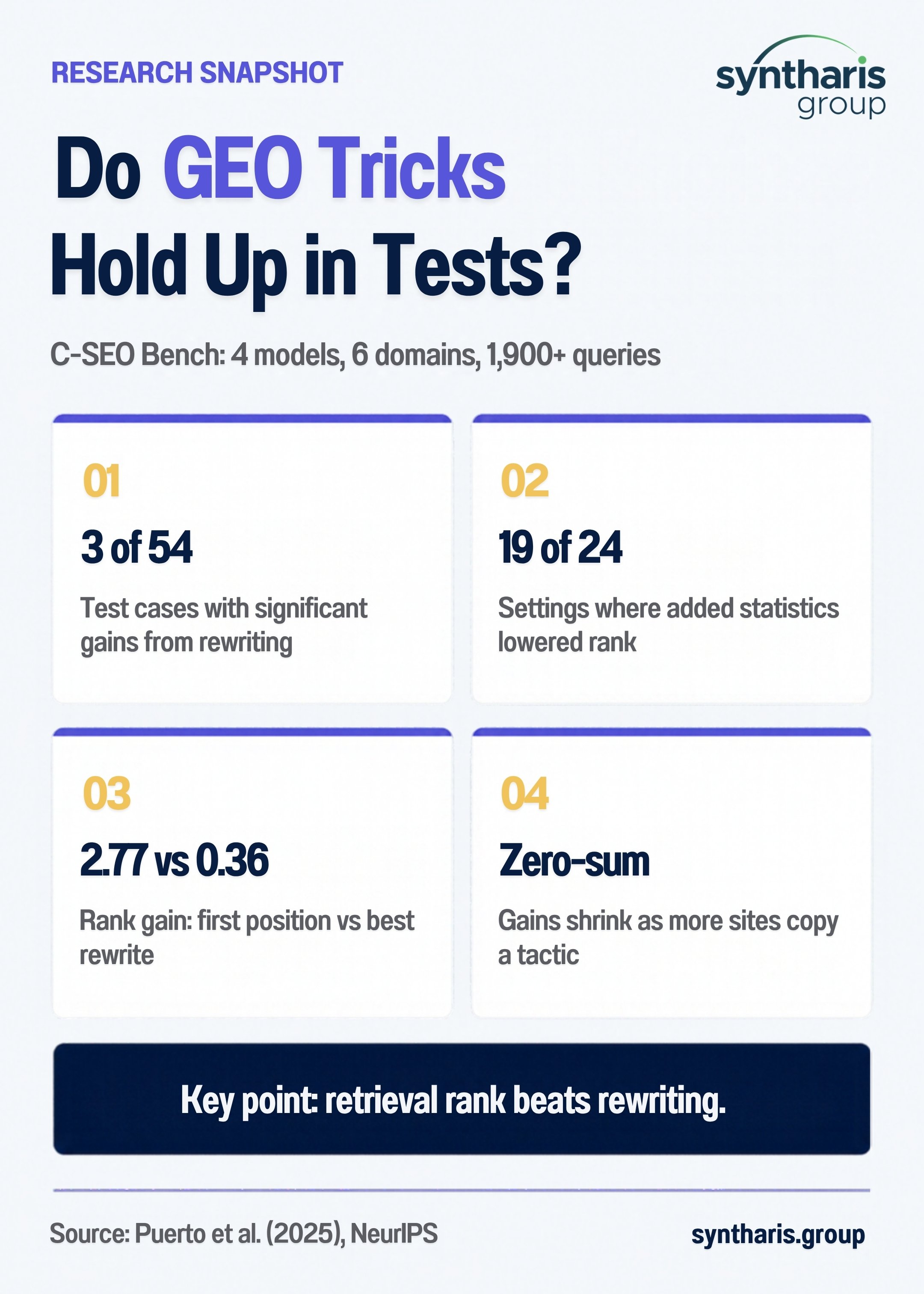
Most methods did nothing measurable. In the authors’ own count, only three of 54 tested cases showed statistically significant gains: LLM guidance in retail and video games, and the combined content improvement in retail, all on GPT-4o-mini. No method worked for the question-answering task, and none worked on Claude 3.5 Haiku.
Several methods made things worse. Adding statistics, one of the stars of the original study, lowered citation rank in 19 of 24 evaluated settings. On Claude 3.5 Haiku, 26 of 30 product recommendation cases showed significant negative effects.
Retrieval position dominated everything. When the authors simply moved a document to the first position in the model’s context, its citation rank improved far more than with any rewrite. On GPT-4o-mini in the retail domain, first position improved rank by 2.77 places on average, against 0.36 for the best rewriting method. The authors concluded that traditional SEO, which determines retrieval order, remains essential and that rewriting can at most complement it.
Gains also shrank as more players adopted a technique. Early adopters of the best methods saw some benefit, but the advantage fell steadily as competitors did the same, approaching zero at full adoption. The authors describe the problem as “congested and zero-sum.”
Why the two studies disagree
The C-SEO authors argue that the studies measured different things. A higher share of words in an answer does not mean the model ranks a source higher. They also point out that the original paper’s position-adjusted figures, read carefully, are consistent with their own finding that rewriting does not reliably move a source up the citation order. Several other differences add up: newer and stronger models, real retrieval order, more domains, and a significance test on every cell.
For a practitioner, the fair reading is this. Rewriting a page with more quotes and numbers can change how much of it a model reuses once it is already in the context. It does not reliably make the model prefer it, it does not replace ranking, and its effect depends on the model, the task and how many competitors do the same.
Other evidence worth knowing
Being cited is not the same as being represented correctly
Nelson Liu, Tianyi Zhang and Percy Liang of Stanford audited four generative search engines of the time (Bing Chat, NeevaAI, Perplexity and YouChat) with human raters, published in Findings of EMNLP 2023. On average, only 51.5 percent of generated sentences were fully supported by their citations, and only 74.5 percent of citations actually supported the sentence they were attached to. The systems have improved since, but the study shows why a citation count alone is a weak success measure. A brand can be cited next to a claim its page never made.
AI search may lean toward third-party sources
A September 2025 preprint by Mahe Chen, Xiaoxuan Wang, Kaiwen Chen and Nick Koudas of the University of Toronto compared AI search services with Google across several verticals, languages and query paraphrases. They report that the AI systems relied far more on earned media, such as independent reviews and publications, than on brand-owned pages or social content, while Google showed a more balanced mix. They also found large differences between AI services in domain diversity, freshness and sensitivity to phrasing, and describe a bias toward big brands. This is a preprint that has not yet passed peer review, so treat the size of the effect with caution. The direction fits with Google’s guidance that what others say about you matters, provided it is genuine.
Manipulation works in the lab and carries real risk
Adversarial research shows that language models can be pushed around. Aounon Kumar and Himabindu Lakkaraju showed in 2024 that an optimized text sequence on a product page could make a model recommend that product first, using a small set of fictitious coffee machines. Fredrik Nestaas, Edoardo Debenedetti and Florian Tramèr, at ICLR 2025, showed that prompt injections hidden in web pages could make AI systems downgrade competitors. These are security findings, not marketing playbooks. Google’s spam policies already cover attempts to manipulate rankings or AI answers, including scaled content abuse, and Google explicitly warns that creating pages for every fan-out query mainly to manipulate results falls under that policy.
Clicks from AI answers are scarce
Pew Research Center analyzed the browsing data of 900 U.S. adults in March 2025, covering 68,879 Google searches. About 18 percent of searches produced an AI summary. When a summary appeared, users clicked a traditional result in 8 percent of visits, against 15 percent without one. They clicked a link inside the summary in just 1 percent of visits, and they ended their browsing session more often (26 percent against 16 percent). Wikipedia, YouTube and Reddit together made up 15 percent of the sources cited in the summaries. Google disputes the conclusion that its AI features reduce valuable traffic and reports that clicks from pages with AI Overviews are of higher quality. Both can be true at once: fewer clicks, but more engaged visitors. For GEO, the takeaway is that visibility inside the answer has value of its own, and that measuring only referral traffic will understate it.
What the platforms tell site owners
On May 15, 2026, Google published “Optimizing your website for generative AI features on Google Search,” announced on the Search Central blog. Its core points:
- Generative features rest on Google’s core ranking and quality systems, so SEO best practices apply.
- Unique, non-commodity content is likely to matter more over time than any other recommendation. Google contrasts generic listicles with first-hand, expert accounts that add something beyond common knowledge.
- Technical basics remain the gate: crawlability, indexing, a page eligible for a snippet, a good page experience, and low duplication.
- Local businesses and retailers should keep Google Business Profiles and Merchant Center data accurate, because AI answers can draw on them.
The guide also lists things site owners can ignore for Google Search: llms.txt files and other special AI markup (Google Search does not use them), “chunking” pages into small pieces, rewriting content specifically for AI, chasing inauthentic mentions, and overinvesting in structured data, which is not required for generative features but still useful for rich results.
In June 2026, Google added a toggle in Search Console that lets site owners decide whether their site appears in and helps ground generative AI features. Sites that opt out get no traffic or impressions from those features, and Google says the setting is not used as a ranking signal for regular results. Google also began showing impressions and page data for generative features in Search Console. Both rolled out to all websites worldwide by August 31, 2026, according to Google. For measurement, Google points to the Generative AI performance report, which covers Search and Discover, and warns that no third-party tool has access to its internal ranking or AI systems.
Microsoft Bing
On February 10, 2026, Microsoft introduced AI Performance in Bing Webmaster Tools as a public preview. It reports total citations, average cited pages per day, page-level citation counts, trends over time, and grounding queries, which Microsoft describes as a sample of the phrases its AI used to retrieve cited content. It covers Copilot, AI summaries in Bing and selected partner integrations, and it does not show clicks. In June 2026, Microsoft added preview features that group grounding queries by intent and topic, show citation share and allow comparisons over time. Bing’s own advice leans slightly more toward structure than Google’s: clear headings, tables and FAQ sections, evidence for claims, fresh content and IndexNow for fast updates.
OpenAI and Anthropic
Neither company publishes optimization guidance comparable to Google’s. Both document their crawlers. OpenAI separates OAI-SearchBot, which decides whether a site can appear in ChatGPT search answers, from GPTBot, which relates to training, and notes that robots.txt changes take about 24 hours to affect search. Anthropic separates ClaudeBot (training), Claude-SearchBot (search indexing) and Claude-User (pages fetched when a user asks) and states that disabling the last two may reduce a site’s visibility in user searches.
Proven, plausible, unknown
Sorting GEO claims by the strength of their evidence helps cut through the noise.
| Claim | Evidence status | Basis |
|---|---|---|
| A page must be crawlable and indexed to be cited | Proven | Platform documentation from Google, OpenAI, Anthropic and Microsoft |
| Retrieval rank strongly shapes which sources get cited | Strong evidence | C-SEO Bench across four models and six domains; Google’s description of RAG |
| Adding quotes, statistics and citations increases visibility | Mixed | Positive in the KDD 2024 study on word-count metrics; null or negative on citation rank in C-SEO Bench |
| Keyword stuffing helps | Not supported | No gain in either study; negative on Perplexity in the original paper |
| llms.txt improves visibility | Not for Google Search; unproven elsewhere | Google says it ignores the file; a related in-document summary helped only in two product domains on one model in C-SEO Bench |
| Third-party coverage raises AI visibility | Plausible | University of Toronto preprint; Google’s guidance on genuine mentions |
| Small content chunks are needed for AI | Contradicted for Google | Google’s 2026 guide; Bing recommends clear structure but not fragmentation |
| Rewriting tricks keep working as competitors adopt them | Unlikely | Zero-sum results in C-SEO Bench |
A practical GEO program in seven steps
Taken together, the research and the platform guidance point to a program that looks less like a bag of tricks and more like disciplined SEO with an eye on how AI systems read evidence.
1. Check eligibility first
Confirm that important pages are indexed and allowed to show snippets. Review robots.txt and any CDN or firewall rules for the search crawlers you want: Googlebot, Bingbot, OAI-SearchBot, Claude-SearchBot and others. Decide training and search access separately. Check the generative AI setting in Search Console. These are simple checks, and they are the only steps on this list with a guaranteed effect.
2. Treat retrieval as the main lever
Since retrieval order dominates citation order in the best available evidence, rankings remain the foundation. That means relevant pages that answer the actual question, sound internal linking, technically clean templates and authority built over time. If your team needs a refresher on crawling, indexing and ranking, our overview of how search engines work in 2026 covers the mechanics. Keep query fan-out in mind: map the sub-questions behind your core topics and make sure your best page answers them well, without spinning up thin pages for each variation.
3. Publish what others cannot copy
Google’s strongest recommendation is non-commodity content, and it fits the logic of RAG. If ten pages say the same thing, the model has no reason to prefer yours. Original data, documented methods, first-hand experience, expert judgment and clear positions give a model something it cannot find elsewhere. Back numbers with named, linkable sources and dates. The original GEO findings on statistics and citations are best read in this light: verifiable evidence helps readers and may help models, but sprinkling invented statistics into a page is both dishonest and, according to C-SEO Bench, often counterproductive.
4. Earn genuine third-party coverage
If AI systems lean on independent sources, being covered by trade media, researchers, associations, review platforms and partners matters. This is classic public relations and thought leadership. Fake mentions, paid fake reviews and forum spam are exactly what Google says will not help and what its spam systems target.
5. Keep your facts consistent everywhere
Models assemble answers from many places. Make sure your company name, services, locations, leadership, prices and key figures match across your website, business profiles, directories, data feeds and social profiles. Inconsistencies invite errors, and as the Stanford audit showed, citation does not guarantee accurate representation.
6. Write for people, structure for scanning
Clear headings, short paragraphs, tables where data is tabular and direct answers near the top help readers and are recommended by Bing. Google says no special format is required. The two positions do not conflict: write well-organized pages for humans and skip formats invented only for machines.
7. Avoid tactics with known downsides
- Keyword stuffing and lists of unusual words: no measured benefit.
- Mass-produced pages for every query variation: risk under Google’s scaled content abuse policy.
- Hidden instructions aimed at AI systems: a manipulation technique from security research and a spam risk.
- Buying tools that promise insight into “internal” Google AI metrics: Google states no third party has that access.
How to measure AI visibility without fooling yourself
Measurement is where most GEO programs are weakest. AI answers vary from run to run, differ by platform and change with every model update. A screenshot of one good answer proves very little. The GEO paper itself sampled five answers per query to deal with that variance, and C-SEO Bench tested every effect for statistical significance. A company program does not need academic rigor, but it does need the same discipline.
A simple measurement protocol
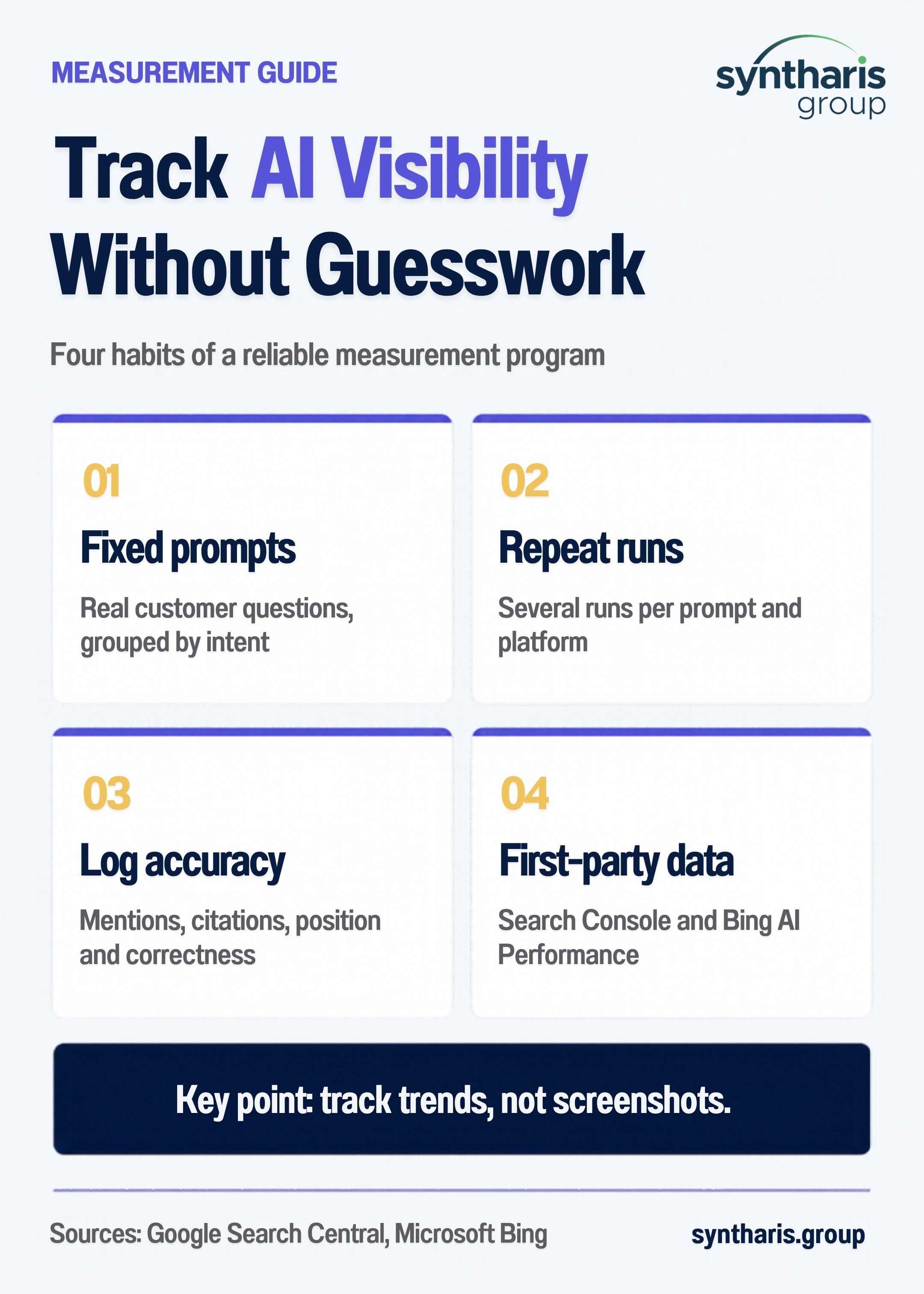
- Build a fixed prompt set. Collect real questions from Search Console queries, sales calls, support tickets and customer interviews. Group them by intent: learning, comparing, buying, troubleshooting. Write them the way customers actually ask, including longer, conversational versions.
- Repeat every prompt. Run each prompt several times per platform, in a clean session without personal history, and log the date, platform, model and location. Single runs mislead.
- Log more than mentions. For each answer, record whether your brand is mentioned, whether one of your URLs is cited, the citation position, which competitors appear, which third-party sources are cited, and whether what the answer says about you is correct.
- Compare with platform data. Use the Generative AI performance report in Google Search Console and AI Performance in Bing Webmaster Tools as first-party checks. Bing’s grounding queries are especially useful because they show which phrases led to your pages being cited.
- Track change over time, not snapshots. Repeat the same set on a fixed schedule and look at trends. When you change a page, note the date so you can relate changes in your logs to it, while keeping in mind that model updates can move results without any action on your side.
Metrics that are worth reporting
| Metric | Definition | Why it matters |
|---|---|---|
| Mention rate | Share of answers that name your brand | Basic awareness inside AI answers |
| Citation rate | Share of answers that link to one of your URLs | The only path to referral traffic |
| Citation position | Average rank of your first citation | The measure used in C-SEO Bench |
| Accuracy rate | Share of mentions that describe you correctly | Protects against confident but wrong answers |
| Share of voice | Your mentions relative to named competitors | Puts your numbers in context |
| Source mix | Which third-party domains are cited for your topics | Shows where earned media efforts should go |
A worked example
Take a hypothetical B2B software company that wants to know where it stands for questions about its product category. The team collects 30 real customer questions, runs each one five times on three AI platforms and logs every answer. That gives 450 answers per measurement round, enough to see patterns rather than anecdotes. Suppose the logs show that the brand is mentioned often but rarely cited, and that the cited sources for comparison questions are mostly two industry review sites and one trade publication. The diagnosis points away from rewriting the homepage and toward two actions: making sure the product’s own comparison pages rank for the fan-out questions behind those prompts, and earning accurate coverage on the third-party sites the systems already trust. Search Console and Bing data then show whether citations to the company’s own pages move in the following months.
This is also how we approach AI visibility work for clients at Syntharis: start with eligibility and retrieval, add evidence and earned coverage, and measure with repeated runs and first-party data. Readers who want the full framework can find it in the free book The AI Visibility SEO & GEO Playbook by our CEO, and our AI visibility consulting for SEO and GEO page describes how we support teams in practice.
What is still unknown
- Live systems are rarely studied. Both major benchmarks control retrieval or run models in a lab setup. Independent, peer-reviewed studies on live products such as AI Mode, ChatGPT search or Copilot are still scarce.
- Personalization and memory. Many assistants now use chat history and user context. How much that changes which sources are cited is largely unmeasured.
- Language and region. C-SEO Bench used English content only. Results for German, Arabic, Japanese or Spanish queries may differ, and the Toronto preprint suggests cross-language stability varies by platform.
- Conversions. Platform reports show citations and impressions. Bing currently shows no clicks, and no platform links AI visibility to revenue. Companies have to connect those dots through their own analytics.
- Durability. Model updates can change citation behavior overnight. Any tactic that works only on one model version should be treated as temporary.
GEO is real in the sense that AI answers are a new place where buyers form opinions. As a separate discipline with its own secret levers, the evidence for it is thin. The most reliable route into AI answers still runs through being findable, being the best-supported source on a question and being described accurately by others.
Sources
- Aggarwal, P., Murahari, V., Rajpurohit, T., Kalyan, A., Narasimhan, K., & Deshpande, A. (2024). GEO: Generative Engine Optimization. Proceedings of the 30th ACM SIGKDD Conference on Knowledge Discovery and Data Mining, 5–16. doi:10.1145/3637528.3671900; preprint: arXiv:2311.09735
- Puerto, H., Gubri, M., Green, T., Oh, S. J., & Yun, S. (2025). C-SEO Bench: Does Conversational SEO Work? NeurIPS 2025. arXiv:2506.11097; NeurIPS 2025 poster page
- Liu, N., Zhang, T., & Liang, P. (2023). Evaluating Verifiability in Generative Search Engines. Findings of EMNLP 2023, 7001–7025. ACL Anthology
- Chen, M., Wang, X., Chen, K., & Koudas, N. (2025). Generative Engine Optimization: How to Dominate AI Search. Preprint, not peer reviewed. arXiv:2509.08919
- Kumar, A., & Lakkaraju, H. (2024). Manipulating Large Language Models to Increase Product Visibility. Preprint. arXiv:2404.07981
- Nestaas, F., Debenedetti, E., & Tramèr, F. (2025). Adversarial Search Engine Optimization for Large Language Models. ICLR 2025. OpenReview
- Chapekis, A., & Lieb, A. (2025, July 22). Google users are less likely to click on links when an AI summary appears in the results. Pew Research Center. pewresearch.org
- Google Search Central. Optimizing your website for generative AI features on Google Search. developers.google.com; announcement of May 15, 2026: Search Central Blog
- Google Search Central. AI features and your website. developers.google.com
- Google Search Central. Spam policies for Google web search. developers.google.com
- Loew, M. (2026, June 3; updated August 31, 2026). New opportunities, control and insights for website owners. Google. blog.google
- Microsoft Bing (2026, February 10). Introducing AI Performance in Bing Webmaster Tools Public Preview. blogs.bing.com
- Microsoft Bing (2026, June). New AI Visibility Insights in Bing Webmaster Tools: Intents, Topics, Citation Share, Compare. blogs.bing.com
- OpenAI. Overview of OpenAI Crawlers. developers.openai.com
- Anthropic. Does Anthropic crawl data from the web, and how can site owners block the crawler? support.claude.com
Frequently asked questions
Is generative engine optimization different from SEO?
Partly. GEO looks at a different outcome: being used and cited inside AI-written answers rather than ranking as a link. The methods overlap heavily, because AI search systems retrieve their sources with search technology first. Google states that optimizing for its generative features is SEO, and the C-SEO Bench study found that retrieval position mattered far more than rewriting tactics.
Does adding statistics and quotes get my content cited by AI?
The evidence is mixed. The KDD 2024 GEO paper found large gains in how much of a source a model reused when quotes, statistics or citations were added. C-SEO Bench, using citation rank on newer models, found no reliable gain and often a loss for added statistics. Well-sourced, accurate evidence is good for readers either way; artificial statistics are not.
Should I create an llms.txt file?
For Google Search it makes no difference, because Google says it ignores the file. Other systems have not committed to using it, and no peer-reviewed study shows a visibility gain from the file itself. It does no harm if you want to maintain one, but it should not take priority over indexing, content quality or earned coverage.
How can I see whether AI systems cite my website?
Start with first-party data: the Generative AI performance report in Google Search Console and AI Performance in Bing Webmaster Tools. Add a fixed set of real customer prompts that you run repeatedly on the platforms that matter to you, logging mentions, citations, citation position and accuracy. Look at trends over weeks and months rather than single answers.
Can I block AI training but still appear in AI search?
With OpenAI and Anthropic, yes. Both use separate crawlers for training and for search, controlled by separate robots.txt tokens. For Google, the Google-Extended token governs training of Gemini models and grounding in the Gemini apps and Vertex AI, and Google says it does not affect inclusion in Search, while appearance in AI Overviews and AI Mode is managed through Search controls and the generative AI setting in Search Console.



We Are Here
to Support You.
Whether you have a question, a project in mind or want to learn more about our services – we look forward to hearing from you.
Our Dubai Office
IFZA Business Park, DDP 65843-001
Silicon Oasis, Dubai, UAE
Business Hours
9:00 AM – 6:00 PM (GST)
AI Visibility: How to Measure Your Brand in ChatGPT, Gemini and Perplexity
PhDr. Oliver Scharfenberg2026-11-20T04:24:18+00:00November 20, 2026|AI Visibility and GEO Articles|
One screenshot of a ChatGPT answer says little about your brand's AI visibility. This guide reviews four recent studies on answer variability, the new first-party reports from Google and Bing, and a step-by-step protocol with sample sizes and confidence ranges.
More Insights
Let’s Talk About Your Visibility.
Book a free consultation and find out how we can increase your visibility in search engines and AI answers.