Google AI Mode SEO: How It Picks Sources and What Google Officially Says
Google AI Mode SEO has turned into a crowded topic, and most of what ranks for it was written in 2025, when AI Mode was a Labs experiment for paying subscribers. A lot has changed since. Google now reports more than one billion monthly AI Mode users, runs it on a newer model, shows ads inside it in a growing list of countries, and has published its own guide to optimizing for generative AI features. Search Console gained a dedicated report and an opt-out setting in 2026. Many ranking articles still say none of these exist.
This guide sorts what Google has documented from what independent researchers have measured and from what vendors claim. It explains how AI Mode builds an answer, which technical conditions decide whether your pages can appear, which controls change what, how to measure results, and what nobody outside Google knows yet. It closes with a 30-day plan and a worked example for a B2B company.
The short answer: Google says there is no separate ranking system to optimize for. AI Mode grounds its answers in Google’s normal search index, so a page has to be indexed, eligible for a snippet and (per Google’s 2026 guide) included in Search generative AI features in Search Console. Beyond that, the levers are the ones classic SEO already uses: helpful content that covers the related questions people ask, crawlable text, accurate structured data and a clean technical setup. What changes is how you measure success and how much control you have over the way your content is used.
What Google AI Mode is in late 2026
AI Mode is the conversational search experience inside Google Search. You type, speak or upload a question, and instead of a ranked list of ten links you get a written answer with links to supporting websites. Google’s documentation describes it as most useful for questions that need further exploration, reasoning or complex comparisons. It is a separate experience from AI Overviews, the summary box that appears on top of some regular results pages, although Google now lets people move from an AI Overview into AI Mode with a follow-up question.
The product has moved fast. The table lists the milestones that matter for SEO, each from a Google announcement or from reporting on one.
| Date | What happened | Why it matters for SEO |
|---|---|---|
| March 5, 2025 | Google introduced AI Mode as an early Labs experiment for Google One AI Premium subscribers, built on a custom version of Gemini 2.0, and described its “query fan-out” technique. | The core retrieval method (many searches behind one question) dates from launch. |
| December 10, 2025 | Last update of Google’s “AI features and your website” page: no extra technical requirements, no special files or schema needed. | The baseline rules for eligibility. |
| May 2026 | Google Search Central published a guide to optimizing for generative AI features in Search. | The most detailed official guidance so far, including what not to do. |
| May 19, 2026 | At I/O, Google said AI Mode had passed one billion monthly users, made Gemini 3.5 Flash the default model in AI Mode globally, and let users continue from an AI Overview into AI Mode. | AI Mode is no longer a niche. The answers come from a newer model than most guides describe. |
| June 3 to August 31, 2026 | Search Console added a generative AI performance report and a Search generative AI control; both reached all websites worldwide by August 31. | First official visibility data and the first AI-specific opt-out inside Search. |
| October 28, 2026 | Ads in AI Mode expanded to ten more countries, with multiturn ads launched in the U.S.; on the same day Google said AI Mode queries are on average three times longer than traditional searches. | Paid and organic results now share the answer space. |
| November 23, 2026 | AI Mode can connect to Google Drive, Google Wallet and the Gemini app, in addition to Gmail, Calendar and Photos. | Answers become more personal, so two users see different results for the same question. |
The usage numbers deserve a careful reading. The one billion figure comes from Google’s I/O post, which also says AI Mode queries had been “more than doubling every quarter since launch”. Google did not say how a monthly user is counted or how the figure splits by country, and no independent party has verified it. In the Q3 2026 earnings call, Sundar Pichai added that one in five AI Mode searches globally use voice, images or documents. These are company statements from investor and marketing contexts. They show direction and scale, not precise market share.
How AI Mode builds an answer: grounding and query fan-out
Two technical ideas explain most of what AI Mode does with your content. Google names both in its own documentation, which is more useful than the many metaphors circulating on agency blogs.
Grounding in the search index
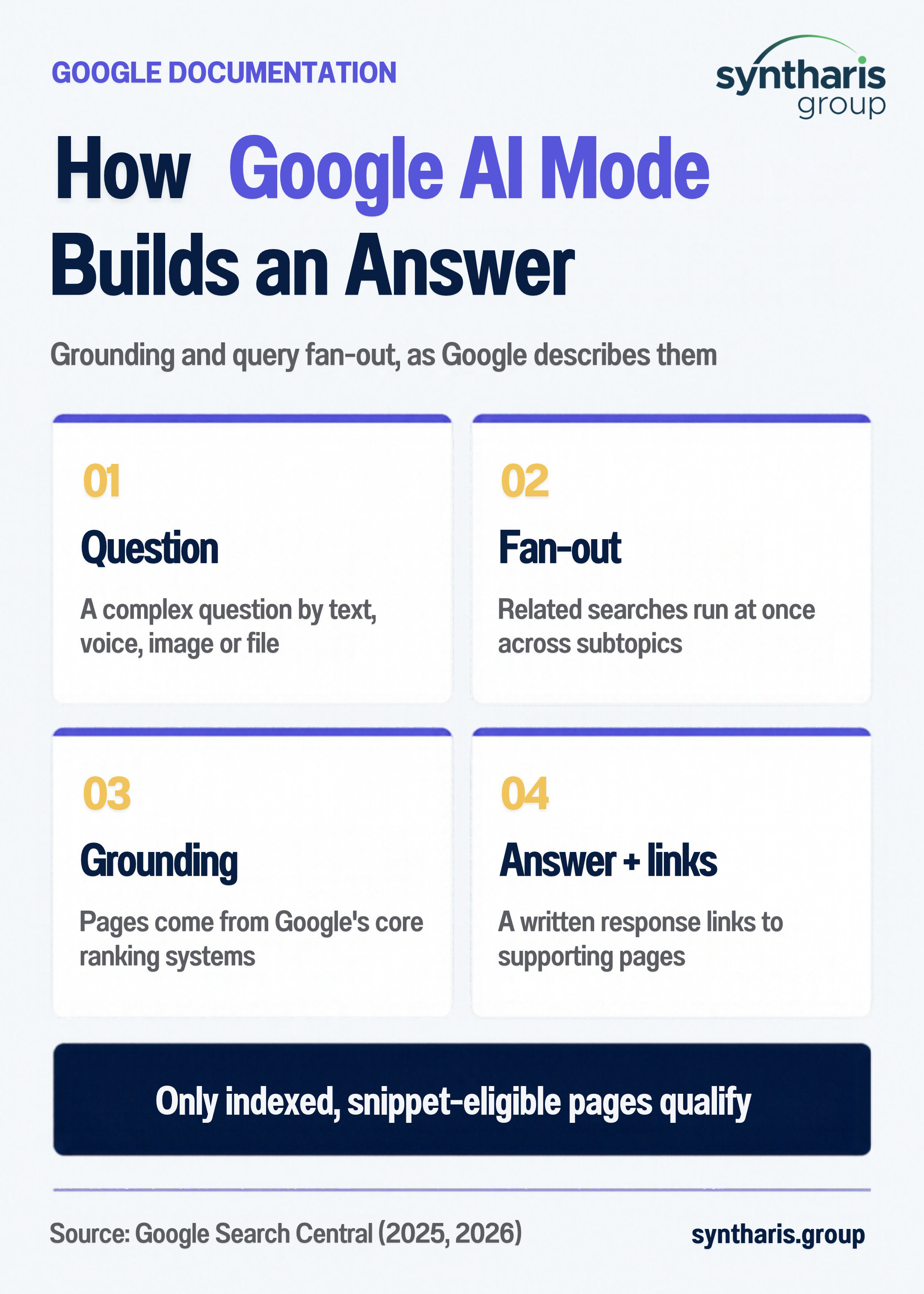
Google’s optimization guide describes retrieval-augmented generation (RAG), which it also calls grounding, as a technique that improves the quality, accuracy and freshness of AI responses by relying on Google’s core search ranking systems. In practice the model does not answer from memory alone. It retrieves pages through the same ranking and quality systems that power regular search, writes a response, and shows clickable links to pages that support what it says. That is why Google keeps repeating that optimizing for generative AI search “is optimizing for the search experience, and thus still SEO”, in the words of its guide.
A page that Google cannot crawl, has not indexed or may not show a snippet for cannot be a supporting link. No amount of AI-oriented formatting changes that.
Query fan-out in Google’s own words
In the March 2025 launch post, Google described query fan-out as “issuing multiple related searches concurrently across subtopics and multiple data sources and then brings those results together”. The 2026 optimization guide gives a shorter definition: a set of concurrent, related queries that the model generates to fetch more relevant search results for the user’s question. Its example is a question about fixing a lawn full of weeds, which can trigger extra searches such as one for the best herbicides for lawns.
Google’s “AI features and your website” page adds two details. Both AI Overviews and AI Mode may use fan-out, and because the advanced models identify more supporting pages, Google can show a wider and more diverse set of links than a classic web search would. The launch post also lists data sources beyond the web index: the Knowledge Graph, real-world information and shopping data for billions of products. For local businesses and retailers, that is why Google keeps pointing to Business Profile and Merchant Center data.
Fan-out changes the unit of competition. In classic search you compete for one query. In AI Mode your page can be retrieved for a sub-question the user never typed, and a competitor can win the main question while you win a supporting step. Google does not publish which sub-queries it generates for a given prompt, how many it runs, or how it weighs the results, so any tool that claims to show “the” fan-out queries for a prompt is estimating.
Why the links differ from the classic results page
Google states that AI Mode and AI Overviews may use different models and techniques, so the responses and links they show will vary. Independent measurement supports the idea that AI answers draw on a different mix of sources than the organic list. A preprint by Haofei Xu, Umar Iqbal and Jacob Montgomery of Washington University in St. Louis, posted in May 2026, collected AI Overviews for 55,393 trending U.S. queries between March 13 and April 21, 2026. Only 41.4 percent of the domains cited in AI Overviews also appeared in the top ten organic results for the same query, and 29.8 percent did not appear anywhere on the first results page. AI Overviews also cited user-generated platforms far less often than the organic results did (14.2 percent of reference URLs versus 41.4 percent).
Two limits apply. The study measured AI Overviews, not AI Mode, and it has not been peer reviewed. Since AI Mode uses fan-out to retrieve even more pages, it is plausible that its source set departs from the top ten at least as much, but no published independent study we could find has measured AI Mode with the same rigor. Ranking in the classic top ten helps; it does not guarantee a citation, and missing from it does not rule one out.
What Google officially says you need, and what you can skip
Eligibility conditions
Google’s “AI features and your website” page states that a page must be indexed and eligible to be shown in Google Search with a snippet, and that “there are no additional technical requirements”. The optimization guide, published later, repeats that condition and adds one: a site must be included in Search generative AI features in Search Console. Inclusion is the default setting, so most sites meet it without doing anything. The difference matters only if someone in your organization changed the setting, which is worth checking once.
Both documents also make clear that meeting the requirements does not guarantee anything. Google may still decide not to crawl, index or show a page.
What Google recommends
The optimization guide’s recommendations are mostly classic SEO with a few points aimed at AI features:
- Create helpful, people-first content with a distinct point of view. The guide calls generic material “commodity content” and uses a “7 Tips for First-Time Homebuyers” style article as its example of what not to produce.
- Organize pages with clear paragraphs, sections and headings, and add relevant images and video where they help.
- Keep important content in text form, allow crawling in robots.txt and at the CDN or hosting level, and follow JavaScript SEO basics.
- Use semantic HTML, without worrying about perfect code.
- Make sure structured data matches the visible text.
- Reduce duplicate content and keep page experience good.
- Keep Merchant Center feeds and Google Business Profile data current if you sell products or serve local customers.
- Verify the site in Search Console and use its generative AI performance report.
Myths Google addresses directly
The more useful part of the guide is what it tells site owners they do not need. Several popular tactics are covered, and the table summarizes Google’s position next to what independent evidence exists.
| Popular claim | Google’s documented position | Evidence status |
|---|---|---|
| You need an llms.txt file or other AI text files | No new machine-readable files, AI text files or markup are needed to appear in AI Overviews or AI Mode. Creating llms.txt is described as fine, but optional. | Official guidance. No independent study shows an effect in Google’s AI features. |
| You need special schema.org markup for AI | No special structured data is required. Structured data still matters for rich results. | Official guidance. |
| Content must be chunked into short passages for AI | The guide says there is no requirement to break content into small pieces for AI systems to understand it. | Official guidance. Clear headings still help readers. |
| Write in a special style or stuff long-tail phrases for AI | Not needed; the systems understand synonyms and meaning. | Official guidance. |
| Create a page for every fan-out sub-question | Pages created mainly to manipulate rankings or AI responses for query variations violate the scaled content abuse spam policy. | Official policy, enforceable through spam actions. |
| Third-party tools can show Google’s internal AI metrics | The guide warns against tools that promise ranking success or claim to use internal Google metrics. | Official guidance. Tools can only sample answers from outside. |
Some of these positions conflict with advice sold under the GEO label. The research on generative engine optimization is more nuanced than either side admits; our review of what the GEO research actually shows covers the academic experiments behind content changes such as adding statistics and quotations. For Google specifically, the official line is that the same signals that make a page useful in regular search also make it useful as a grounding source.
Official statements, independent evidence and vendor claims
Much of the confusion about AI Mode comes from mixing three kinds of sources. Google’s documentation says what Google intends and allows. Independent research measures what happens, usually for AI Overviews and usually with a delay. Vendors publish quick studies with large numbers, often to sell a tracking product. All three can be useful if you know which one you are reading.
| Finding | Source and type | How much weight it carries |
|---|---|---|
| Users clicked a regular result in 8% of visits to Google results pages with an AI summary, versus 15% without one; links inside the summary got clicks in 1% of visits. | Pew Research Center, browsing data of 900 U.S. adults, March 2025, 68,879 searches (independent). | Strong for AI Overviews in 2025. It does not measure AI Mode. |
| Users ended their browsing session on 26% of pages with an AI summary, versus 16% of pages with traditional results only. | Pew Research Center, same study (independent). | Strong for AI Overviews in 2025. |
| AI Overviews appeared for 13.7% of trending queries overall, and for 64.7% of question-form queries versus 9.5% of others. | Xu, Iqbal and Montgomery, 2026 (academic preprint). | Solid method, not yet peer reviewed, AI Overviews only. |
| 11.0% of 98,020 atomic claims in AI Overviews were not supported by the cited pages; 4.1% were contradicted or in conflict with them. | Xu, Iqbal and Montgomery, 2026 (academic preprint; claims labeled with an LLM and checked against human labels). | Useful as an order of magnitude for factual risk. |
| English and Chinese versions of the same 500 questions produced AI Overviews with almost no shared source hosts (Jaccard overlap 0.034). | Li, Guan, Cai, Liu and Pierri, Politecnico di Milano, 2026 (academic preprint). | Relevant for international sites: each language competes in its own source pool. |
| Clicks from results pages with AI Overviews are “higher quality”, meaning users spend more time on the site. | Google’s AI features documentation (company statement). | No data published. Treat as a claim to test in your own analytics. |
| Click-through rates are similar for sponsored and organic product list items within AI Mode. | Google Ads blog, internal U.S. data from August 20 to September 3, 2026 (company statement). | Unverified, two-week window, product listings only. |
| In ChatGPT, fan-out searches were triggered for 78.3% of commercial prompts but 3.6% of informational prompts in a set of 80 real user prompts. | Tannenbaum, 2026 (preprint by the CEO of an AI visibility vendor). | Small sample, different engine, commercial interest. A hypothesis worth testing for AI Mode, not a fact about it. |
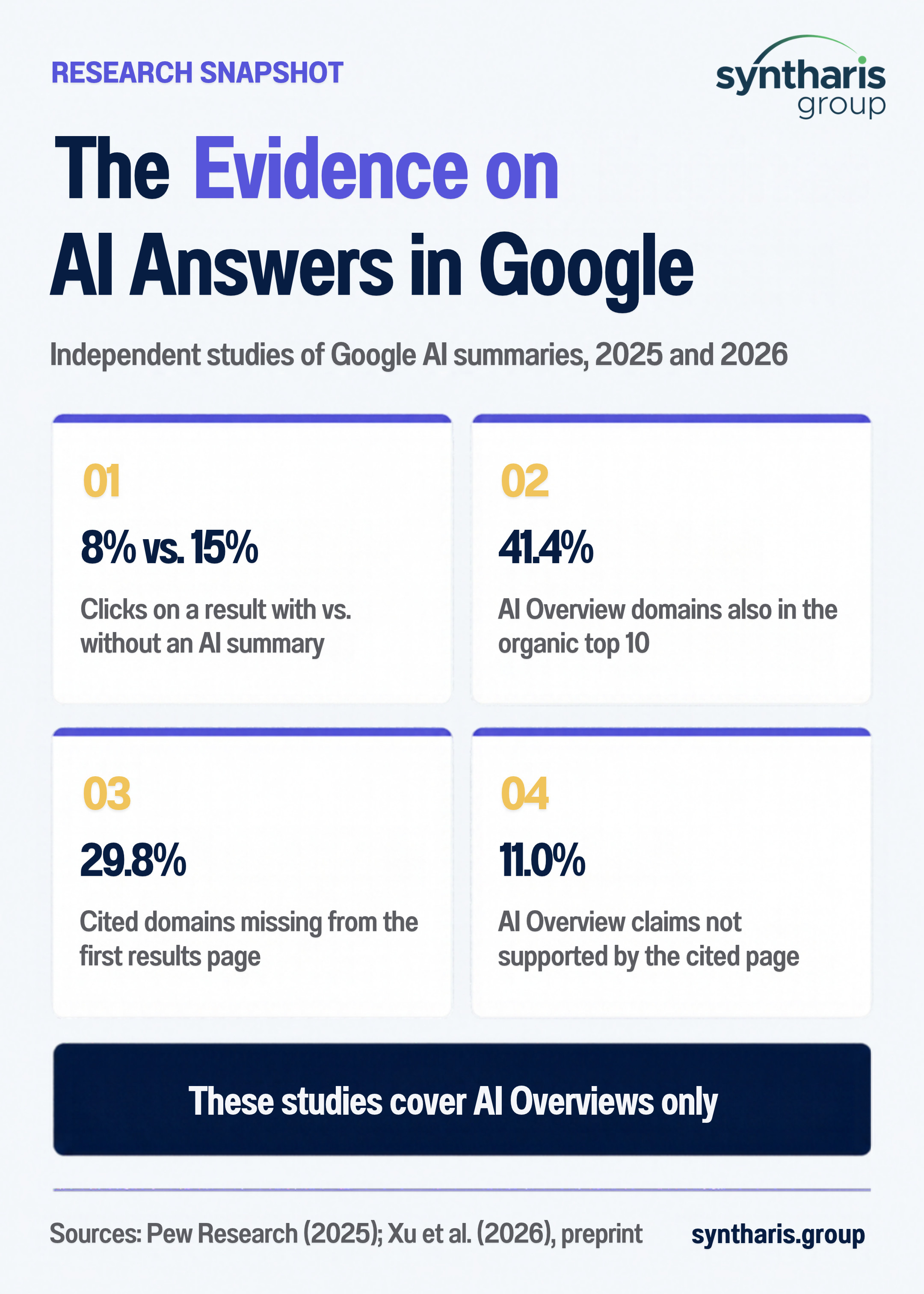
Two findings need context. The first is the gap between the two preprints on how often AI Overviews appear: 13.7 percent in the Washington University study versus about 97 percent in the Milan study. The difference comes from the query sets. Xu and colleagues used trending Google queries; the Milan team used questions from a research dataset and ran them in a logged-in browser. Any statistic about “how often AI answers appear” depends on which questions were asked and by whom. The same applies to the share-of-voice numbers that tracking tools report for AI Mode.
The second is accuracy. If roughly one in ten claims in an AI Overview is not supported by the cited source, then appearing in an answer and being represented correctly are two separate goals. B2B companies with complex offers should check what AI answers say about them, not only whether they are mentioned. The measurement section below explains how to check answers for accuracy as well as presence.
Controls: what each lever actually changes
Google documents its controls for generative AI on a single page, last updated November 24, 2026. They differ in scope, and choosing the wrong one can remove a site from search or leave it in the training data it wanted to leave.
| Control | Where you set it | Effect on AI Overviews and AI Mode | Effect on regular Search |
|---|---|---|---|
| Search generative AI control | Search Console, Settings | “Exclude” removes your links and content from AI Overviews, AI Mode and generative AI features in Discover; content is no longer used as input for AI responses. Google says the exclusion takes effect within one to two days. | None. Google states it is not used as a ranking or inclusion signal for other parts of Search. |
| nosnippet or max-snippet (robots meta tag or X-Robots-Tag) | Page HTML or HTTP header | Limits the text shown and can prevent content from being used as a direct input for AI Overviews and AI Mode. | Also limits or removes snippets in regular results. |
| data-nosnippet | HTML attribute on specific elements | Keeps the marked passages out of snippets and previews, including in AI features. | Same for regular snippets. |
| noindex | Page HTML or X-Robots-Tag | Removes the page from AI features. | Removes the page from Search entirely. |
| Google-Extended | robots.txt token | None. It does not control AI Overviews or AI Mode. | None. Google says it is not a ranking signal and does not affect inclusion in Search. |
| GoogleOther | robots.txt | None. | None; it covers non-Search crawls such as research and development. |
Google-Extended is the control most often misunderstood. According to Google’s crawler documentation, it governs whether crawled content is used to train future foundation models and to ground certain commercial generative AI products “aside from Search and other Search services”, such as the Gemini app. Blocking it keeps your content out of those uses while leaving AI Mode untouched. Google also notes that blocking it does not stop the same or similar content from other websites being used, and that models may still mention or link to domains that have opted out.
Google has also said it intends to support a shared machine-readable signal for AI training preferences in robots.txt, developed with other AI providers, in early 2027. The current documentation names the token user-agent: __usage_ai-training. Until it is live, the token has no effect at Google.
Each control has a cost. Excluding a site from Search generative AI features means, in Google’s words, “you won’t receive any traffic or impressions from these features”. For a publisher whose business depends on people reading the full article, that may be a reasonable trade. For a B2B firm that wants to be named when buyers research a category, it usually is not. A middle path for sensitive passages, such as pricing details that change often or gated research, is data-nosnippet on those elements.
Ads and personalization change the playing field
Two 2026 developments make AI Mode less comparable to the classic organic results page than it was at launch.
Ads inside answers
On October 28, 2026, Google announced that ads in AI Mode were scaling to Australia, Canada, India, Kenya, Malaysia, New Zealand, Nigeria, Pakistan, the Philippines and Singapore, with Brazil, Mexico and the United Kingdom planned for the fourth quarter of 2026. It also launched multiturn ads in the U.S., which can appear in follow-up questions within a conversation. Ads carry a “Sponsored” label. For organic strategy, this means commercial questions in AI Mode increasingly have paid placements next to the generated answer, as classic results pages have had for decades. Teams that handle both paid and organic search should review AI Mode together, since a paid placement and an organic citation can appear in the same answer. Our marketing consulting work treats the two as one budget question for that reason.
Personal context
Google’s Personal Intelligence features let AI Mode draw on a user’s own Gmail, Calendar and Photos, and since November 23, 2026, on Drive, Wallet and Gemini app conversations, if the user connects them. Google also announced that AI Overviews and AI Mode will tailor responses to a user’s recent search context. Connecting apps is optional. For measurement, this has a clear consequence: an answer you see in a clean browser is one sample from a distribution, and a buyer who has spent a week researching your category may see a different one.
Measuring AI Mode performance
AI Mode visibility can be measured from three angles. None gives the full picture alone.
Search Console: what the generative AI report shows
Google’s generative AI performance report for Search covers AI Overviews and AI Mode. According to the help documentation, it shows one metric, impressions, defined as how many times links to your site were shown to a user in a generative AI feature on Google Search. You can break it down by page, country, device and date, and filter between text-based and multimodal searches. It does not include data from Search Labs experiments, and it does not show the queries behind the impressions. If your site has too few impressions, or has been excluded through the control above, the report stays empty.
Traffic from AI features is still counted in the regular Performance report under the “Web” search type, mixed with classic results. That makes the two reports complementary: the generative AI report tells you which pages Google showed in AI features and when; the regular report shows the total clicks those pages earned, from all formats.
A practical way to use them together:
- Export generative AI impressions by page for the last three months.
- Join them with clicks, engagement and conversions for the same pages from the Performance report and your analytics tool.
- Flag pages with rising AI impressions but flat or falling clicks. These are candidates for a better title, a clearer answer near the top, or a stronger reason to visit, such as original data or a tool.
- Flag pages with high organic rankings but no AI impressions. Check snippet controls, indexing status and whether the page answers related sub-questions at all.
Analytics and conversions
Google says clicks from results pages with AI Overviews are higher quality. You can test that claim for your own site by comparing engaged sessions and conversion rates on landing pages before and after their AI impressions rose. If you sell to businesses, add a “How did you hear about us?” field to inquiry forms. Self-reported answers are imperfect, but they capture buyers who read an AI answer and later searched for your name directly, which no click report shows.
Sampling answers
Search Console does not show what AI Mode says about you. For that you need to run your own questions repeatedly or use a tool that does it. AI answers vary from run to run, so a single screenshot proves little. Studies published in 2026 suggest running each prompt several times across several days and reporting rates with confidence intervals; our article on how to measure AI visibility walks through prompt sets, sample sizes and worked calculations. For AI Mode specifically, log whether you were signed in, the country and language, and whether personal context was switched on.
A 30-day Google AI Mode SEO plan
This plan assumes a B2B website with a few hundred pages and a small marketing team. Larger sites can run the same steps on one section first.
Week 1: technical eligibility
- Confirm in Search Console that the Search generative AI control is set to include your site.
- Crawl the site for noindex, nosnippet and max-snippet rules and confirm each one is intended.
- Check robots.txt, CDN and firewall rules for blocks on Googlebot. Security tools sometimes rate-limit crawlers without anyone noticing.
- Use URL Inspection on your ten most important commercial pages to confirm they are indexed and render their main text without depending on user interaction.
- Decide on a Google-Extended policy for training and Gemini app grounding. Remember that it does not affect AI Mode.
Week 2: question mapping
- List the 20 to 40 questions buyers ask before they contact you, from sales notes, support tickets and Search Console queries.
- For each, write down the sub-questions a careful answer would need: costs, alternatives, risks, timelines, legal requirements, comparisons.
- Map each sub-question to an existing page, a section on a page, or a gap. Fill gaps by improving existing pages first. Google’s spam policy warns against mass-producing pages for query variations.
Week 3: content upgrades
- Put a direct answer near the top of each key page, followed by the detail an expert would add.
- Add what generic pages lack: your own data, worked examples, prices or ranges where you can publish them, named authors with real expertise, dates of last review.
- Check that structured data matches the visible content, and that company facts (locations, services, leadership) are consistent across your site and your Google Business Profile.
Week 4: measurement baseline
- Record generative AI impressions by page as a baseline, plus clicks and conversions for the same pages.
- Run a fixed set of prompts in AI Mode several times across several days, signed out, and note whether you are mentioned, cited and described correctly.
- Write down every change you made and when. Without a change log, later shifts cannot be attributed.
Worked example: one B2B question, many retrieval paths
Take a mid-sized manufacturer’s HR director who asks AI Mode: “How can a 400-person manufacturing company improve its employer brand to hire more engineers?” The fan-out searches below are our illustration of what such a question plausibly involves. Google does not publish the actual sub-queries.
| Plausible sub-question | Page type that can answer it | What would make that page a strong source |
|---|---|---|
| What is an employer value proposition? | Explainer or glossary section | A clear definition, an example from manufacturing, a source |
| Which channels do engineers use when job hunting? | Research summary or blog post | Recent survey data with dates and sample sizes |
| Do employer awards or seals affect applications? | Study page or evidence review | Experimental or peer-reviewed evidence, with limits stated |
| What does employer branding cost for a mid-sized firm? | Service page or pricing guide | Ranges, what drives cost, what is included |
| How long until results show? | Case study or FAQ | Timelines with measured outcomes, named or anonymized client context |
A consultancy that publishes only a service page with marketing claims competes for one or two of these steps at best. A firm that has a solid explainer, a research summary and a transparent pricing guide gives the system several chances to retrieve it, each for a different sub-question. That is also how a careful buyer reads, so the investment pays off with or without AI Mode. If you want help building that kind of structure, our AI visibility, SEO and GEO consulting starts with this mapping.
For international firms there is one more step. The Milan preprint found that English and Chinese versions of the same questions drew on almost entirely different sources. If you sell in several languages, map and measure each language separately. A strong English page does not carry your German or Spanish visibility.
What remains unknown
Site owners can see the inputs Google documents and the outputs they sample, but not the steps in between.
- Selection logic: Google has not said how AI Mode chooses which retrieved pages to cite, how many fan-out queries it runs per question, or how much weight freshness, authority and passage relevance carry.
- Click behavior in AI Mode: the best independent click data (Pew) covers AI Overviews in 2025. Comparable public data for AI Mode does not exist yet, and Google’s claim of higher-quality clicks is unquantified.
- Query data: the generative AI report shows impressions without queries, so you cannot see which questions led to an appearance.
- Personalization effects: how strongly connected apps and recent search context change which sources are cited has not been measured publicly.
- Stability: models change. AI Mode moved from a custom Gemini 2.0 at launch to Gemini 3.5 Flash in May 2026, and each change can shift citation patterns without notice.
What is reasonably established: eligibility depends on indexing, snippets and the Search Console setting; Google-Extended does not affect AI Mode; AI answers draw on a wider and different set of sources than the top ten; and their factual accuracy is good but imperfect. Everything else, including most “ranking factor” lists for AI Mode, is inference. For a broader view of how search has changed and which classic practices still hold, see our overview of AI SEO in 2026. Readers who want the full framework can download our CEO’s free book, The AI Visibility SEO & GEO Playbook, from the research and publications page.
Sources
- Google Search Central. AI features and your website. Last updated December 10, 2025.
- Google Search Central. Optimizing your website for generative AI features on Google Search.
- Google Search Central Blog (2026, May). A new resource for optimizing for generative AI in Google Search.
- Google Search Central. Control how your content is used for generative AI at Google. Last updated November 24, 2026.
- Google Crawling Infrastructure. Google-Extended. Last updated November 24, 2026.
- Google Search Central Blog (2026, June 3). Introducing Search Generative AI performance reports in Search Console.
- Search Console Help. Generative AI performance report (Search).
- Search Console Help. Search generative AI control.
- Stein, R. (2025, March 5). Expanding AI Overviews and introducing AI Mode. Google.
- Reid, E. (2026, May 19). A new era for AI Search. Google.
- Pichai, S. (2026, October 28). Q3 2026 earnings call: Remarks from our CEO. Google.
- Thakur, S. (2026, October 28). Ads in AI Mode expand to new markets. Google.
- Malik, A. (2026, November 23). Google Search’s AI Mode can now tap into Drive and Wallet for more personalized responses. TechCrunch.
- Chapekis, A., & Lieb, A. (2025, July 22). Google users are less likely to click on links when an AI summary appears in the results. Pew Research Center.
- Xu, H., Iqbal, U., & Montgomery, J. M. (2026). Measuring Google AI Overviews: Activation, Source Quality, Claim Fidelity, and Publisher Impact. arXiv:2605.14021. Preprint.
- Li, Y., Guan, E., Cai, Y., Liu, G., & Pierri, F. (2026). Auditing Source Exposure in Baidu and Google AI Search. arXiv:2609.24407. Preprint.
- Tannenbaum, B. (2026). From Prompt to Recommendation: A Fitted Stage Model of Brand Visibility in AI Search. arXiv:2609.23162. Preprint; the author leads an AI visibility company.
Frequently asked questions
Do I need special optimization for Google AI Mode?
According to Google, no. A page needs to be indexed, eligible for a snippet and included in Search generative AI features in Search Console, which is the default. Google says you do not need llms.txt, special schema or AI-specific formatting. The work that helps is the same as for regular search: useful, specific content that covers the related questions buyers ask, plus a clean technical setup.
What is query fan-out in Google AI Mode?
Query fan-out is Google’s term for running several related searches at the same time behind one user question. The model splits a question into subtopics, searches for each, and combines the results into one answer with links. Your page can be retrieved for a sub-question the user never typed, which is why covering the related questions in your field matters.
Can I see AI Mode performance in Search Console?
Yes, partly. Since August 31, 2026, every site has a generative AI performance report that shows impressions in AI Overviews and AI Mode by page, country, device and date. It does not show queries or clicks. Clicks from AI features are counted in the regular Performance report under the “Web” search type, together with classic results.
How do I keep my content out of AI Mode but stay in Google Search?
Use the Search generative AI control in Search Console and choose to exclude your site. Google says this removes your links and content from AI Overviews, AI Mode and generative AI features in Discover within one to two days, without affecting rankings in regular search. You will also lose all traffic and impressions from those features. For individual passages, the data-nosnippet attribute is a narrower option.
Does blocking Google-Extended remove my site from AI Mode?
No. Google-Extended controls whether your content is used to train Google’s foundation models and to ground certain AI products outside Search, such as the Gemini app. Google states it has no effect on Search inclusion or ranking, and AI Overviews and AI Mode are managed through the Search Console control instead.
Does ranking in the top ten guarantee a citation in AI Mode?
No. Independent research on AI Overviews found that only about 41 percent of cited domains also appeared in the top ten organic results for the same query, and almost 30 percent did not appear on the first page at all. No comparable public study exists for AI Mode yet, but Google itself says AI Mode shows a wider and more diverse set of links than a classic search.



We Are Here
to Support You.
Whether you have a question, a project in mind or want to learn more about our services – we look forward to hearing from you.
Our Dubai Office
IFZA Business Park, DDP 65843-001
Silicon Oasis, Dubai, UAE
Business Hours
9:00 AM – 6:00 PM (GST)
Google AI Mode SEO: How It Picks Sources and What Google Officially Says
PhDr. Oliver Scharfenberg2026-11-26T01:49:58+00:00November 26, 2026|AI Visibility and GEO Articles|
How Google AI Mode picks its sources, what Google's 2026 documentation requires, which controls change what, and how to measure results. With independent evidence, a worked B2B example and a 30-day plan.
More Insights
Let’s Talk About Your Visibility.
Book a free consultation and find out how we can increase your visibility in search engines and AI answers.